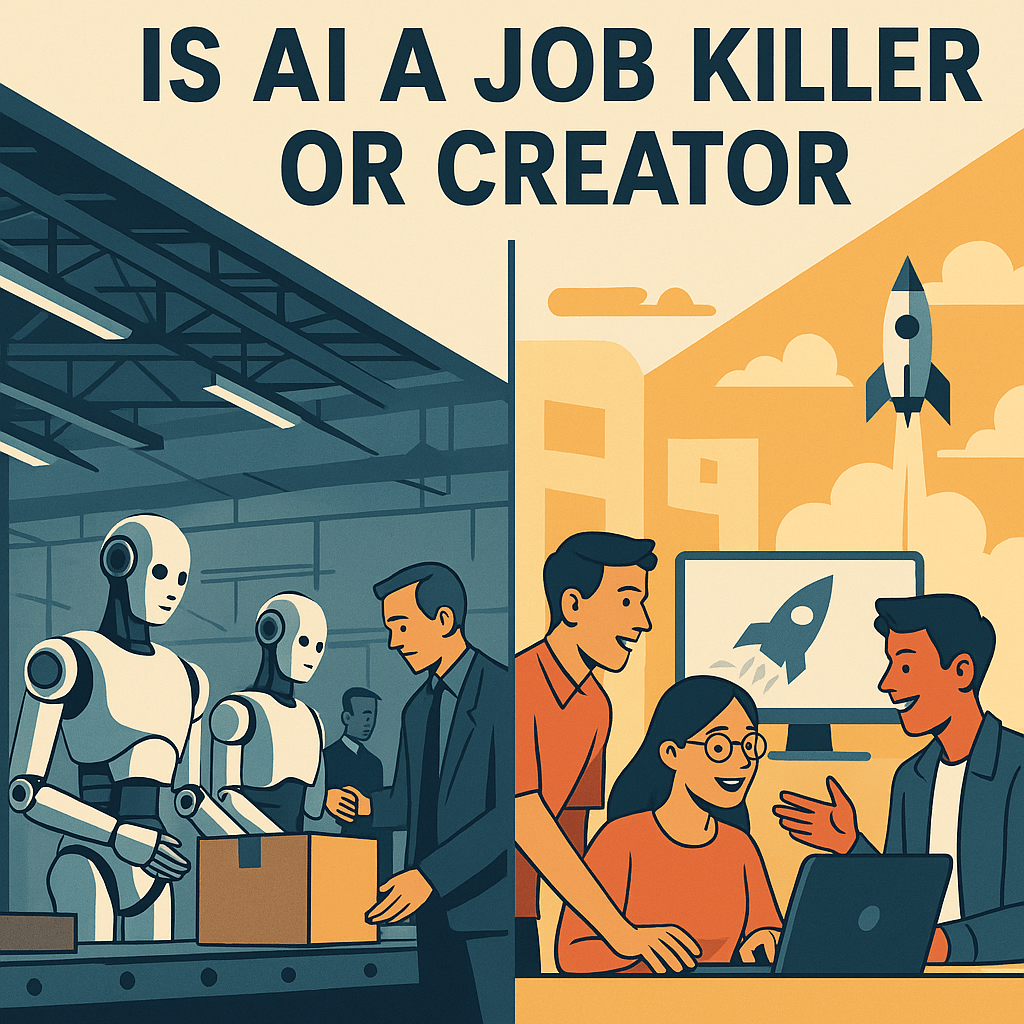
As a high school student preparing to study computational linguistics in college, I often think about how AI is reshaping the world of work. Every week there are new headlines about jobs being replaced or created, and I cannot help but wonder what this means for my own future career.
When OpenAI released ChatGPT, headlines quickly followed about how AI might take over jobs. And in some cases, the headlines weren’t exaggerations. Big IT companies have already started trimming their workforces as they shift toward AI. Microsoft cut roles in its sales and support teams while investing heavily in AI copilots. Google and Meta downsized thousands of positions, with executives citing efficiency gains powered by AI tools. Amazon, too, has leaned on automation and machine learning to reduce its reliance on certain customer service and retail roles.
These stories feed into an obvious conclusion: AI is a job killer. It can automate repetitive processes, work 24/7, and reduce costs. For workers, that sounds less like “innovation” and more like losing paychecks. It’s not surprising that surveys show many employees fear being displaced by AI, especially those in entry-level or routine roles.
Bill Gates’ Perspective: Why AI Won’t Replace Programmers
But not everyone agrees with the “AI takes all jobs” narrative. Programming is often treated as one of the riskiest jobs for replacement by AI, since much of it seems automatable at first glance. To this specific job, Bill Gates has offered a different perspective. Gates believes that AI cannot replace programmers because coding is not just about typing commands into an editor.
Key Points from Bill Gates’ Perspective
- Human Creativity and Judgment
Gates explains that programming requires deep problem-solving and creative leaps that machines cannot reproduce. “Writing code isn’t just typing – it’s thinking deeply,” he says. Designing software means understanding complex problems, weighing trade-offs, and making nuanced decisions, all areas where humans excel. - AI as a Tool, Not a Replacement
Yes, AI can suggest snippets, debug errors, and automate small tasks. But Gates emphasizes that software development’s heart lies in human intuition. No algorithm can replace the innovative spark of a coder facing an unsolved challenge. - Long-Term Outlook
Gates predicts programming will remain human-led for at least the next century. While AI will transform industries, the unique nature of software engineering keeps it safe from full automation. - Broader Implications of AI
Gates does not deny the risks. Jobs will shift, and some roles will disappear. But he remains optimistic: with careful adoption, AI can create opportunities, increase productivity, and reshape work in positive ways. - Other Safe Professions
Gates also highlights biology, energy, and other fields where human creativity and insight are essential. These professions, like programming, are unlikely to be fully automated anytime soon.
In short, Gates sees AI not as a replacement, but as an assistant, a way to amplify human creativity rather than eliminate it. He explained this view in an interview summarized by the Economic Times: Bill Gates reveals the one profession AI won’t replace—not even in a century.
AI as a Job Creator
If we flip the script, AI is also a job creator. Entire industries are forming around AI ethics, safety, and regulation. Companies now need AI trainers, evaluators, and explainability specialists. Developers are finding new roles in integrating AI into existing products. Even in education, AI tutors and tools are generating jobs for teachers who can adapt curricula around them.
As Gates points out, the key is using AI wisely. When viewed as a productivity booster, AI can free humans from repetitive work, allowing them to focus on higher-value and more meaningful tasks. Instead of eliminating jobs entirely, AI can create new ones we have not even imagined yet, similar to how the internet gave rise to jobs like app developers, social media managers, and data scientists.
The Third Option: Startup Rocket Fuel
There’s also another perspective I find compelling. A recent ZDNet article, Is AI a job killer or creator? There’s a third option: Startup rocket fuel, points out that AI doesn’t just destroy or create jobs, it also accelerates startups.
Think of it this way: AI lowers the cost of entry for innovation. Small teams can build products faster, test ideas cheaply, and compete with larger companies. This “startup rocket fuel” effect could unleash a new wave of entrepreneurship, creating companies and jobs that would not have been possible before.
My Perspective
As a high school student planning to study computational linguistics, I see both sides of this debate. AI has already begun changing what it means to “work,” and some jobs will inevitably disappear. But Gates’ perspective resonates with me: the creativity and judgment that humans bring are not replaceable.
Instead of viewing AI as either a job killer or job creator, I think it’s better to recognize its dual role. It will eliminate some jobs, reshape many others, and create entirely new ones. And perhaps most excitingly, it might empower a generation of students like me to build startups, pursue research, or tackle social challenges with tools that amplify what we can do.
In the end, AI isn’t writing the future of work for us. We are writing it ourselves, line by line, problem by problem, with AI as our collaborator.
Takeaway
AI will not simply erase or hand out jobs. It will redefine them, and it is up to us to decide how we shape that future.
 CompLing Insights
Leave a comment