Introduction
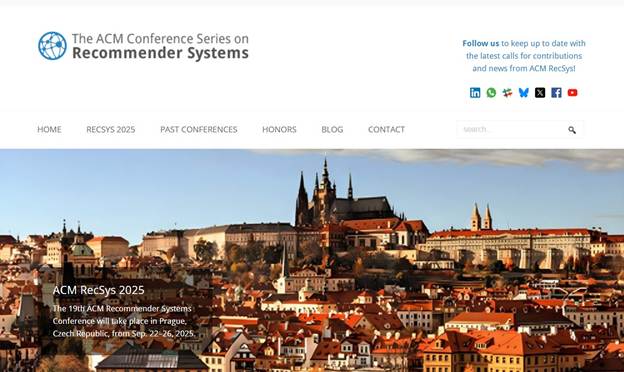
The ACM Conference on Recommender Systems (RecSys) 2025 took place in Prague, Czech Republic, from September 22–26, 2025. The event brought together researchers and practitioners from academia and industry to present their latest findings and explore new trends in building recommendation technologies.
This year, one of the most exciting themes was the growing overlap between natural language processing (NLP) and recommender systems. Large language models (LLMs), semantic clustering, and text-based personalization appeared everywhere, showing how recommender systems are now drawing heavily on computational linguistics. As someone who has been learning more about NLP myself, it is really cool to see how the research world is pushing these ideas forward.
Paper Highlights
A Language Model-Based Playlist Generation Recommender System
Relevance:
Uses language models to generate playlists by creating semantic clusters from text embeddings of playlist titles and track metadata. This directly applies NLP for thematic coherence and semantic similarity in music recommendations.
Abstract:
The title of a playlist often reflects an intended mood or theme, allowing creators to easily locate their content and enabling other users to discover music that matches specific situations and needs. This work presents a novel approach to playlist generation using language models to leverage the thematic coherence between a playlist title and its tracks. Our method consists in creating semantic clusters from text embeddings, followed by fine-tuning a transformer model on these thematic clusters. Playlists are then generated considering the cosine similarity scores between known and unknown titles and applying a voting mechanism. Performance evaluation, combining quantitative and qualitative metrics, demonstrates that using the playlist title as a seed provides useful recommendations, even in a zero-shot scenario.
An Off-Policy Learning Approach for Steering Sentence Generation towards Personalization
Relevance:
Focuses on off-policy learning to guide LLM-based sentence generation for personalized recommendations. Involves NLP tasks like controlled text generation and personalization via language model fine-tuning.
Abstract:
We study the problem of personalizing the output of a large language model (LLM) by training on logged bandit feedback (e.g., personalizing movie descriptions based on likes). While one may naively treat this as a standard off-policy contextual bandit problem, the large action space and the large parameter space make naive applications of off-policy learning (OPL) infeasible. We overcome this challenge by learning a prompt policy for a frozen LLM that has only a modest number of parameters. The proposed Direct Sentence Off-policy gradient (DSO) effectively propagates the gradient to the prompt policy space by leveraging the smoothness and overlap in the sentence space. Consequently, DSO substantially reduces variance while also suppressing bias. Empirical results on our newly established suite of benchmarks, called OfflinePrompts, demonstrate the effectiveness of the proposed approach in generating personalized descriptions for movie recommendations, particularly when the number of candidate prompts and reward noise are large.
Enhancing Sequential Recommender with Large Language Models for Joint Video and Comment Recommendation
Relevance:
Integrates LLMs to enhance sequential recommendations by processing video content and user comments. Relies on NLP for joint modeling of multimodal text (like comments) and semantic user preferences.
Abstract:
Nowadays, reading or writing comments on captivating videos has emerged as a critical part of the viewing experience on online video platforms. However, existing recommender systems primarily focus on users’ interaction behaviors with videos, neglecting comment content and interaction in user preference modeling. In this paper, we propose a novel recommendation approach called LSVCR that utilizes user interaction histories with both videos and comments to jointly perform personalized video and comment recommendation. Specifically, our approach comprises two key components: sequential recommendation (SR) model and supplemental large language model (LLM) recommender. The SR model functions as the primary recommendation backbone (retained in deployment) of our method for efficient user preference modeling. Concurrently, we employ a LLM as the supplemental recommender (discarded in deployment) to better capture underlying user preferences derived from heterogeneous interaction behaviors. In order to integrate the strengths of the SR model and the supplemental LLM recommender, we introduce a two-stage training paradigm. The first stage, personalized preference alignment, aims to align the preference representations from both components, thereby enhancing the semantics of the SR model. The second stage, recommendation-oriented fine-tuning, involves fine-tuning the alignment-enhanced SR model according to specific objectives. Extensive experiments in both video and comment recommendation tasks demonstrate the effectiveness of LSVCR. Moreover, online A/B testing on KuaiShou platform verifies the practical benefits of our approach. In particular, we attain a cumulative gain of 4.13% in comment watch time.
LLM-RecG: A Semantic Bias-Aware Framework for Zero-Shot Sequential Recommendation
Relevance:
Addresses domain semantic bias in LLMs for cross-domain recommendations using generalization losses to align item embeddings. Employs NLP techniques like pretrained representations and semantic alignment to mitigate vocabulary differences across domains.
Abstract:
Zero-shot cross-domain sequential recommendation (ZCDSR) enables predictions in unseen domains without additional training or fine-tuning, addressing the limitations of traditional models in sparse data environments. Recent advancements in large language models (LLMs) have significantly enhanced ZCDSR by facilitating cross-domain knowledge transfer through rich, pretrained representations. Despite this progress, domain semantic bias arising from differences in vocabulary and content focus between domains remains a persistent challenge, leading to misaligned item embeddings and reduced generalization across domains.
To address this, we propose a novel semantic bias-aware framework that enhances LLM-based ZCDSR by improving cross-domain alignment at both the item and sequential levels. At the item level, we introduce a generalization loss that aligns the embeddings of items across domains (inter-domain compactness), while preserving the unique characteristics of each item within its own domain (intra-domain diversity). This ensures that item embeddings can be transferred effectively between domains without collapsing into overly generic or uniform representations. At the sequential level, we develop a method to transfer user behavioral patterns by clustering source domain user sequences and applying attention-based aggregation during target domain inference. We dynamically adapt user embeddings to unseen domains, enabling effective zero-shot recommendations without requiring target-domain interactions.
Extensive experiments across multiple datasets and domains demonstrate that our framework significantly enhances the performance of sequential recommendation models on the ZCDSR task. By addressing domain bias and improving the transfer of sequential patterns, our method offers a scalable and robust solution for better knowledge transfer, enabling improved zero-shot recommendations across domains.
Trends Observed
These papers reflect a broader trend at RecSys 2025 toward hybrid NLP-RecSys approaches, with LLMs enabling better handling of textual side information (like reviews, titles, and comments) for cold-start problems and cross-domain generalization. This aligns with recent surveys on LLMs in recommender systems, which note improvements in semantic understanding over traditional embeddings.
Final Thoughts
As a high school student interested in computational linguistics, reading about these papers feels like peeking into the future. I used to think of recommender systems as black boxes that just show you more videos or songs you might like. But at RecSys 2025, it is clear the field is moving toward systems that actually “understand” language and context, not just click patterns.
For me, that is inspiring. It means the skills I am learning right now, from studying embeddings to experimenting with sentiment analysis, could actually be part of real-world systems that people use every day. It also shows how much crossover there is between disciplines. You can be into linguistics, AI, and even user experience design, and still find a place in recommender system research.
Seeing these studies also makes me think about the responsibility that comes with more powerful recommendation technology. If models are becoming better at predicting our tastes, we have to be careful about bias, fairness, and privacy. This is why conferences like RecSys are so valuable. They are a chance for researchers to share ideas, critique each other’s work, and build a better tech future together.
— Andrew
5,279 hits
 CompLing Insights
Leave a comment