Introduction
In this blog post, I’d like to share recent findings suggesting AI is quietly reshaping the way we talk. You may be already aware of the trend of AI’s reshaping the way we write since the wide usage of ChatGPT and other LLM models in facilitating the text/script generation, particularly in writing research papers. See the discussion in my past blog post “Is the Increasing Trend of Leveraging LLMs like ChatGPT in Writing Research Papers Concerning?”.
Florida State University’s Study
A new study from Florida State University shows that large language models are starting to influence spoken language, not just written text. Researchers analyzed over 22 million words from unscripted science and tech podcasts, comparing episodes from before ChatGPT (2019–2021) with episodes after its release (2023–2025).
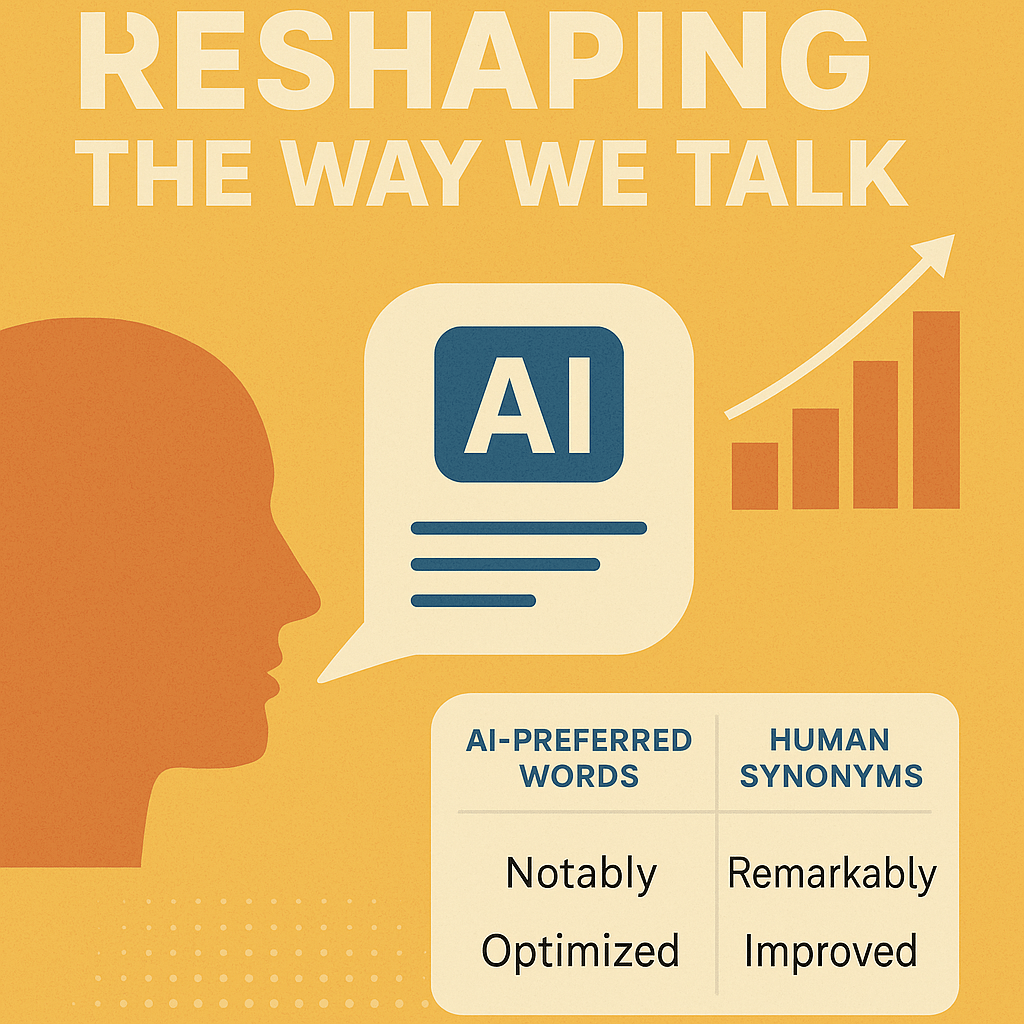
They found that words commonly used by AI models, such as “delve,” “boast,” and “meticulous,” are showing up more often in everyday conversation, while their close synonyms stayed flat.
The researchers call this phenomenon “lexical seepage,” where AI-preferred words gradually leak into the way people naturally talk.
How the Shift Happens
The study links this effect to psychology concepts like implicit learning and priming. People pick up on repeated words, even without realizing it, and then use them themselves. In other words, AI is not just helping us write. It may also be subtly shaping the way we speak. Importantly, the changes were observed in unscripted talk, in addition to formal speeches or scripted lectures.
Global Patterns and Concerns
This is not only happening in the U.S. A study in Germany found similar patterns on YouTube, suggesting the trend is global. Experts warn that if companies like OpenAI, Anthropic, and Google fine-tune their models in different ways, people might start adopting slightly different speech patterns. Over time, this could flatten dialects, erase regional slang, and reduce creativity. Some argue we need new benchmarks that push AI to use more diverse language instead of over-relying on the same set of words.
Natural Adoption vs. AI Amplification
The Florida State team also makes an important point: not everything can be pinned on AI.
“It is possible that these words have simply entered a phase of natural, rapid adoption, akin to the rise of expressions like ‘touch base,’ ‘dude,’ and ‘awesome’ in the mid-2000s.”
In this view, LLMs overuse words that were already becoming popular, but they still act as amplifiers that speed up language change. Even if AI is not the original source of these trends, the fact that machine-generated text can influence how humans speak is significant.
Final Thoughts
As a high school student, I find this both fascinating and a little worrying. On the one hand, it shows how powerful AI really is in shaping culture, not just technology. On the other hand, if AI makes everyone talk the same way, that could erase some of the creativity and uniqueness that makes language fun. Just like with social media, the full impact may take years to understand. For now, I think it’s important to keep asking questions about how AI is changing not just what we write, but also what we say.
Further Reading
- “AI Is Quietly Reshaping the Way We Talk.” Fast Company, https://www.fastcompany.com/91398460/ai-is-quietly-reshaping-the-way-we-talk.
- Anderson, Bryce, Riley Galpin, and Tom S. Juzek. Model Misalignment and Language Change: Traces of AI-Associated Language in Unscripted Spoken English. arXiv, 2025, doi:10.48550/arXiv.2508.00238.
- Yakura, Hiromu, et al. Empirical Evidence of Large Language Model’s Influence on Human Spoken Communication. arXiv, 2024, doi:10.48550/arXiv.2409.01754.
— Andrew
5,364 hits
 CompLing Insights
Leave a comment