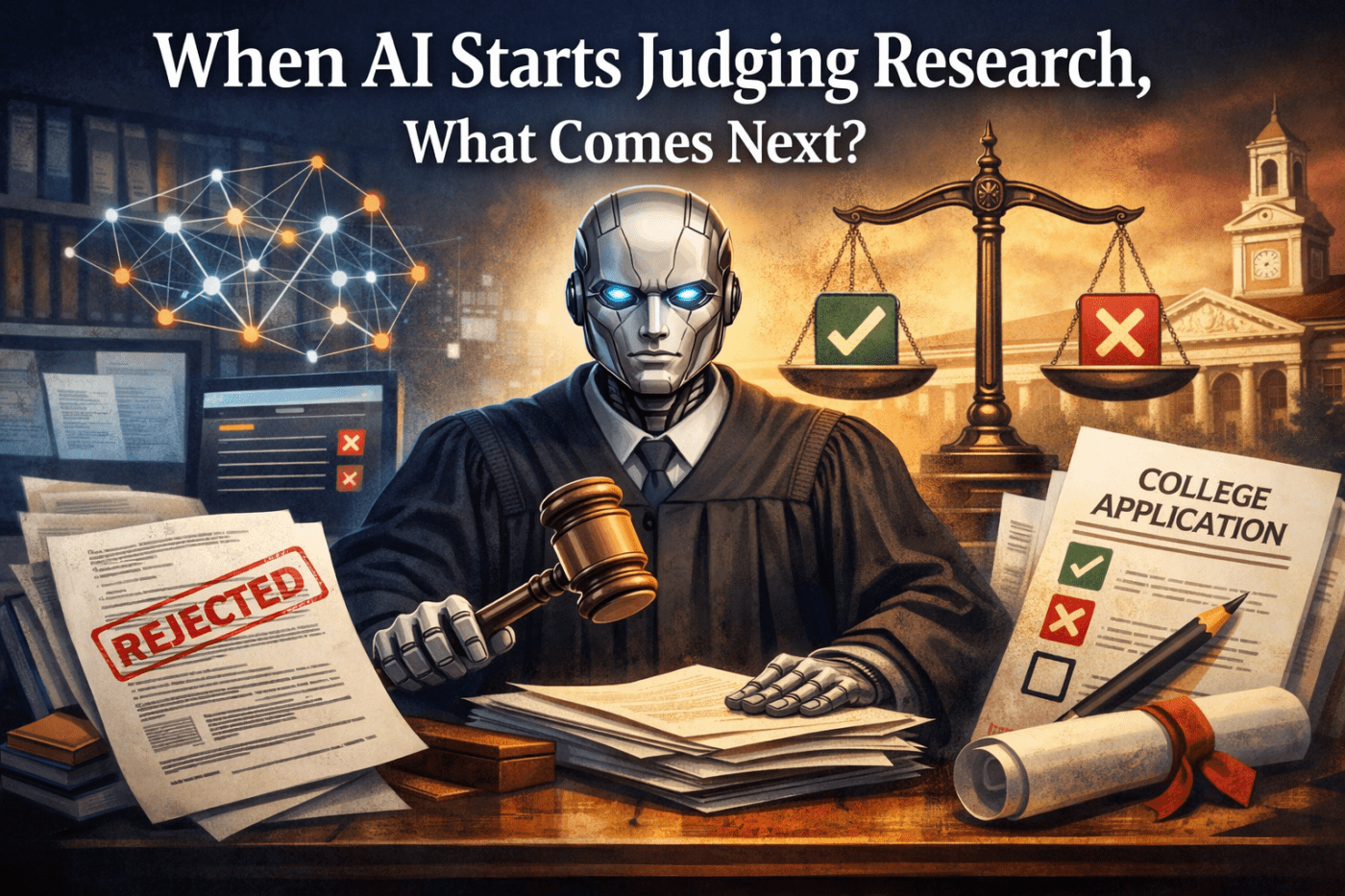
Introduction: From AI-Assisted Research to AI-Assisted Judgment
In my past two blog posts, I focused on how AI is already reshaping academic research. In “The Productivity Paradox of AI in Scientific Research,” I wrote about how AI can expand productivity while narrowing the range of questions science tends to pursue. In “Citation Hallucinations at NeurIPS and What They Teach Us,” I looked at a different failure mode: AI’s ability to generate polished but false citations that can slip into scholarly work if no one checks carefully. This new story feels like the next stage of that same conversation. It is no longer just about how AI helps produce research. It is about how AI may begin influencing how research is judged.
That is why ABC Money’s article, “Stanford’s AI-Powered Peer Review System Is Rejecting More Papers Than Ever,” stood out to me. The headline is dramatic, but the deeper issue is broader than one Stanford-linked tool or one claim about rising rejection rates. The real question is whether academia is moving toward a system in which AI increasingly helps shape which papers are seen as rigorous, original, and worth publishing.
What Stanford’s AI Reviewer Actually Represents
According to Stanford’s Agentic Reviewer overview, the system takes a paper, retrieves relevant literature, and generates a structured review. The project also says that in an internal evaluation built around ICLR 2025 submissions, the AI’s score correlation with a human reviewer was roughly comparable to the correlation between two human reviewers. That is a notable result. But it is still not the same thing as proving that the system can do peer review well in the fullest sense of the term.
That distinction matters. A model can learn the patterns of past reviewing behavior without understanding whether those patterns reflect good judgment. If peer review already tends to favor polished presentation, trendy topics, and familiar methods, then an AI trained on those signals may reinforce those biases rather than correct them. In that sense, this connects directly to the concern I raised in my productivity-paradox post: AI may accelerate what is already legible and well supported while doing far less for unusual, risky, or interdisciplinary ideas.
It is also worth being precise about what Stanford’s tool appears to be doing. The public materials describe it as an AI review and feedback system, but they do not show that Stanford or major journals have handed final publication decisions over to it. So the ABC Money headline may go further than the official project materials themselves. Even so, the broader trend is real. AI is moving closer to the front end of scholarly evaluation.
AI Is Already Entering Peer Review
And this is not just hypothetical. A 2026 study on ICLR 2025 describes an official AI feedback tool that was deployed to provide reviewers with post-review suggestions in a live, high-stakes conference setting (Chen et al. 2026). The researchers present this as the first empirical evidence of such a tool in a live review process. Importantly, the tool did not replace human reviewers or make final accept-reject decisions. It instead offered feedback on reviews themselves, flagging issues like (1) vagueness or genericity, (2) possible misunderstandings of the paper, and (3) unprofessional tone.
There are also examples outside conference review. openRxiv announced in November 2025 that it was enabling review options that included author-centered AI tools, reflecting a broader effort to expand the review ecosystem around bioRxiv and medRxiv. That is not the same as automated rejection, but it is another sign that AI-based review infrastructure is starting to become normal.
Meanwhile, AI is entering review even when it is not always built directly into official platforms. That is one reason this issue feels larger than any single Stanford project. Once AI becomes a routine part of writing, feedback, and manuscript assessment, it starts shaping what counts as clear, persuasive, and acceptable long before a final decision is made. This is where the conversation stops being just about software and starts becoming a conversation about institutional judgment.
Why This Matters Beyond Research
That concern becomes even more interesting when we look at college admissions. Admissions offices face a similar problem: too many applications, too little time, and pressure to make consistent decisions. The logic for using AI sounds very similar to the logic in peer review. A machine can process transcripts faster, extract structured information from essays, and help staff manage volume.
Some colleges have openly acknowledged using AI in parts of that process. UNC-Chapel Hill says it uses AI programs to provide data points about students’ Common App essays and school transcripts, including writing style, grammar, and course rigor, so that admissions staff can focus on essay content, grades, and curriculum strength. That is a clear example of AI entering applicant screening, even if UNC does not present it as automated decision-making.
Other institutions have been reported as experimenting in related ways. Associated Press reporting carried by VPM says some colleges are publicly incorporating AI into admissions, including Virginia Tech’s use of an AI-powered essay reader, while Caltech has been described as using an AI-supported authenticity check for student-submitted research projects. These are different use cases, but together they show how quickly machine-assisted evaluation is spreading into high-stakes educational settings.
At the same time, some universities are drawing a clear boundary. The University of California says every application is read and that each application gets multiple reviews. USC similarly says it is committed to keeping admissions a human process “absent of AI or other technology.” That contrast matters because it shows institutions still have choices. AI adoption is not inevitable in the same form everywhere.
The Bigger Theme: Institutional Judgment Under Pressure
This is why I find the Stanford story so interesting even if the headline itself may overstate the immediate facts. It points to a larger shift. In my earlier posts, I wrote about AI changing how research gets produced and how mistakes can enter that process. This story points to the next step: AI influencing how research gets filtered, rewarded, and legitimized. And once the same logic appears in college admissions too, it becomes harder to dismiss as a niche issue.
My own view is that AI can be useful in review when it remains a support tool rather than a gatekeeper. If it helps a researcher catch weakly supported claims, missing citations, or unclear phrasing, that seems valuable. If it helps a reviewer notice that their comments are too vague or unnecessarily harsh, that also seems valuable. But once institutions begin leaning on AI to define novelty, merit, authenticity, or promise, the stakes change. Those are not just clerical judgments. They are interpretive ones. And interpretive judgments are exactly where hidden assumptions can have the biggest consequences.
Conclusion: Fast, Scalable, Persuasive, but Not Necessarily Wise
At bottom, I think this is becoming one of the central questions of the AI era: what happens when institutions under pressure begin outsourcing pieces of judgment to systems that are fast, scalable, and persuasive, but not necessarily wise? That question matters for researchers trying to publish, for students trying to get admitted, and for anyone who cares about whether important but unconventional ideas still have a fair chance.
If universities, conferences, and journals keep moving in this direction, transparency will matter a great deal. Students, authors, reviewers, and researchers should know when AI is being used, what role it actually plays, and what decisions remain fully human. Without that clarity, people may assume they are being evaluated by experienced readers when an unseen machine is shaping the first impression. That would not just be a fairness problem. It would also be a trust problem.
References
ABC Money. “Stanford’s AI-Powered Peer Review System Is Rejecting More Papers Than Ever.” March 11, 2026. Stanford’s AI-Powered Peer Review System Is Rejecting More Papers Than Ever
Stanford Agentic Reviewer / PaperReview.ai. “Tech Overview.” Stanford’s Agentic Reviewer overview
Chen et al. “What Happens When Reviewers Receive AI Feedback in Their Reviews?” ACM CHI 2026. https://arxiv.org/abs/2602.13817
openRxiv. “Enabling options for review: from training and transparency to author-centered AI tools.” November 6, 2025. https://openrxiv.org/enabling-review-options/
UNC-Chapel Hill Undergraduate Admissions. “Does Undergraduate Admissions use AI and why?” https://admissions.unc.edu/faqs/does-undergraduate-admissions-use-ai-and-why/
University of California. “How the University of California evaluates student applications.” https://www.universityofcalifornia.edu/news/how-the-university-of-california-evaluates-student-applications
USC Undergraduate Admission Blog. “Humanizing the Admission Process.” February 23, 2026. https://www.admissionblog.usc.edu/p/humanizing-the-admissions-process
Associated Press / VPM. “Welcome to the new era of college admissions: AI may be scoring your essay.” December 2, 2025. https://www.vpm.org/news/2025-12-02/college-admissions-artificial-intelligence-virginia-tech-juan-espinoza
— Andrew
5,251 hits
 CompLing Insights
Leave a comment