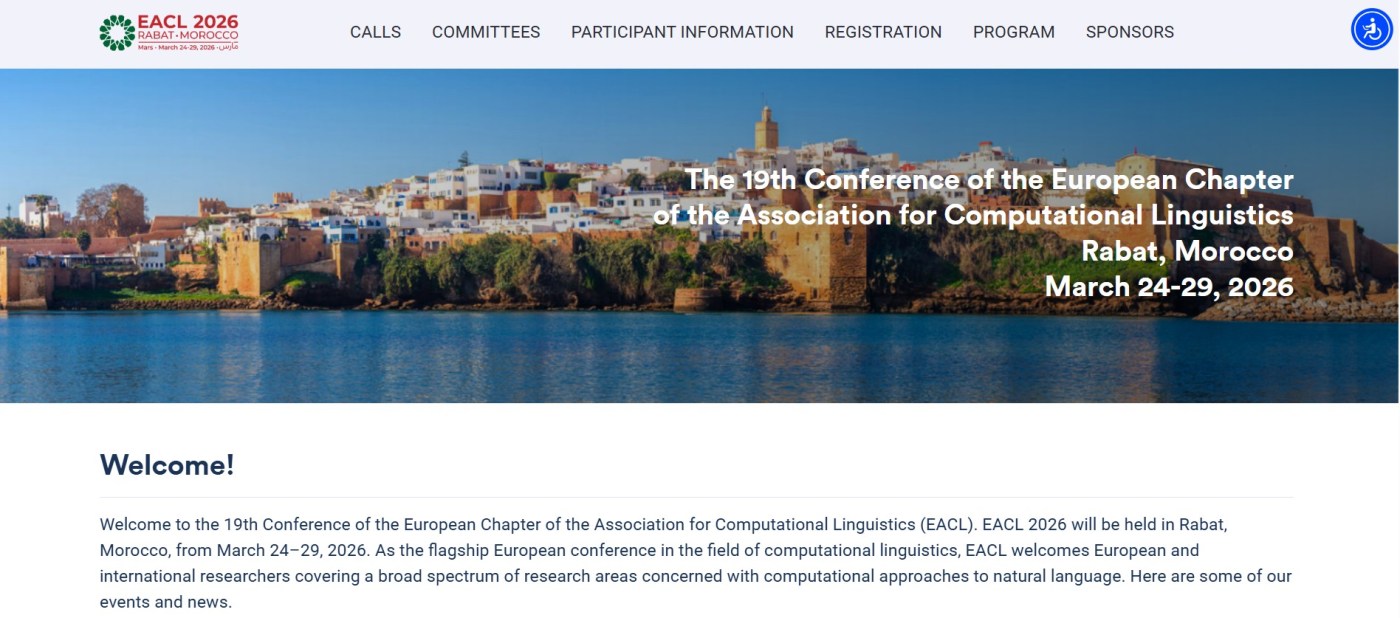
For the past few years, a lot of AI discussion has centered on scale. Bigger models, bigger datasets, bigger claims. But when I looked through EACL 2026, I came away with a different impression. The most interesting story was not just that language technology is getting more powerful. It was that computational linguistics is becoming more demanding about what counts as progress.
This year’s conference suggests that the field is entering a new phase. Researchers are paying closer attention to multilingual evaluation, cross-linguistic reliability, and the gap between fluent output and genuine linguistic competence. EACL 2026 includes hundreds of long papers, short papers, demos, findings papers, and workshops, but what stands out is the kind of questions those papers are asking. Increasingly, the field is less satisfied with asking whether a model performs well on a benchmark and more interested in whether that benchmark actually tells us anything meaningful.
That shift matters. Computational linguistics has reached a point where sounding convincing is no longer enough. A model may generate polished text, but that does not mean it reasons well, generalizes across languages, or works fairly across different linguistic communities. EACL 2026 reflects a growing awareness of that problem. Its program includes sessions on multilingual reliability, multilingual diversity and resource-aware scaling, historical and multiscript language processing, and evaluation under stress testing. Even one of the plenary talks, “Omnilinguality, Scaling AI to Any language,” points directly to the conference’s broader focus. (2026.eacl.org)
Moving past the obsession with scale
Public conversations about AI still tend to reward scale. That makes sense to a point. Larger systems often do unlock new capabilities. But EACL 2026 suggests that the next phase of computational linguistics may be shaped less by model size and more by whether models can be evaluated honestly across languages and contexts.
That is one reason the First Workshop on Multilingual Multicultural Evaluation caught my attention. Its goal is not simply to add more languages to existing benchmarks. It focuses on improving multilingual evaluation in terms of accuracy, scalability, comparability, and fairness, while also incorporating cultural and social perspectives. That is a deeper challenge. It asks not only whether our systems work in many languages, but whether our methods for judging them are themselves too narrow.
As a student who is also trying to learn how research in computational linguistics actually works, I think this is one of the most important developments right now. Multilingual NLP has sometimes been treated as English NLP extended outward. Translate the task, rerun the benchmark, report the score. But language diversity is not that simple. Languages differ in structure, meaning-making, and social use. If our evaluation methods smooth over those differences, then our conclusions about model ability may be misleading from the start.
Multilingual agents are raising the stakes
EACL 2026 also makes clear that agents are no longer just a product trend. They are becoming a serious evaluation problem for computational linguistics. Once language models are expected to act as assistants, judges, or multi-step decision makers across languages, the question becomes whether their behavior remains reliable when the language changes.
One paper that stood out to me was MEDAL: A Framework for Benchmarking LLMs as Multilingual Open-Domain Dialogue Evaluators. The paper starts with a striking issue: LLMs are increasingly being used to evaluate dialogue quality, but many of the benchmarks for testing those evaluators are static, outdated, and not very multilingual. MEDAL addresses this by generating multilingual dialogues with multiple LLMs and studying how well strong models can judge them. The authors find real cross-lingual differences and show that even strong judge models struggle with nuanced issues like empathy, common sense, and relevance. (aclanthology.org)
What makes this especially interesting is that it reveals a second layer of uncertainty. We already worry about whether language models produce good outputs. Now we also have to worry about whether language models can reliably evaluate other language models, especially across languages. That is a very computational linguistics problem. It sits at the intersection of dialogue, evaluation, pragmatics, and multilinguality. It also shows how weaknesses do not disappear when models are placed in evaluative roles. They can become built into the systems we trust to judge quality.
Evaluation is becoming central, not secondary
If I had to summarize one message from EACL 2026, it would be this: evaluation is no longer a side issue. It is becoming one of the field’s central concerns.
A good example is Cards Against Contamination: TCG-Bench for Difficulty-Scalable Multilingual LLM Reasoning. This paper addresses one of the biggest benchmark problems today: contamination. If models have already seen benchmark data during training, then high scores become much harder to interpret. The authors respond by introducing a new benchmark based on a text-based trading card game, with English and Arabic versions and adjustable difficulty. Their findings show that performance drops as difficulty increases, that model size does not map neatly onto strategic ability, and that a notable gap remains between English and Arabic performance. (aclanthology.org)
That matters because it reflects a larger change in the field’s mindset. It is no longer enough for a benchmark to be widely used or easy to cite. It has to be trustworthy. If a model performs well because it has effectively memorized familiar patterns, then benchmark success may tell us less about reasoning than we think.
Another EACL 2026 paper pushes this idea even further. Garbage In, Reasoning Out? Why Benchmark Scores are Misleading for LLM Social Reasoning argues that benchmark success can be fragile and overly dependent on wording, framing, and context. The authors call for process-oriented evaluation rather than relying only on static outcome-based metrics. That is an important shift. The field is becoming less interested in whether a model happened to get the answer right and more interested in what kind of reasoning, if any, led to that answer. (aclanthology.org)
To me, that is one of the healthiest signs in current computational linguistics. A stronger evaluation culture makes a field more precise. It also makes it harder for hype to stand in for evidence.
Language diversity is moving to the center
The other major pattern I noticed at EACL 2026 is that language diversity is being treated less like a side topic and more like a core research challenge. You can see that just from the workshops: African NLP, languages using Arabic script, low-resource language models, low-resource machine translation, Turkic languages, similar languages and dialects, field linguistics, and the Iranian language family. This is not a small corner of the conference. It is a substantial part of the conversation. (aclanthology.org)
One paper that captures this especially well is Measuring Linguistic Competence of LLMs on Indigenous Languages of the Americas. The authors evaluate five major model families on 13 Indigenous languages across tasks including language identification, cloze completion, and grammatical feature classification. Their results show major variation across both languages and model families, with many combinations performing near chance. That is a useful reminder that claims of multilingual capability often hide a much less even reality. (aclanthology.org)
What I like about this paper is that it treats underrepresented languages as serious tests of linguistic competence, not as afterthoughts. The authors note that many Indigenous languages include rich morphology and nonstandardized orthographies, which complicate both tokenization and evaluation. These are not just difficult edge cases. They are important cases for understanding whether models have learned anything linguistically meaningful beyond high-resource patterns.
A related example is CETVEL, a benchmark for Turkish that evaluates language understanding, generation, and cultural capacity. What stands out here is not just the breadth of the benchmark, but the fact that it includes Turkish history, idiomatic usage, and culturally grounded content. The paper also finds that Turkish-centric instruction-tuned models can underperform broader multilingual or general-purpose models. That complicates the simple assumption that more language-specific automatically means better. It suggests that language-specific evaluation needs to be culturally grounded and methodologically strong if it is going to tell us something useful. (aclanthology.org)
What this says about the field
So what does EACL 2026 reveal about the next phase of computational linguistics?
To me, it reveals a field that is becoming more multilingual, more skeptical, and more serious about methodology. The excitement around large language models is still there, but conferences like this suggest that researchers are becoming less willing to accept easy narratives about progress. Instead, they are asking where models fail, how evaluation breaks down, and which linguistic communities are still being underserved.
It also suggests that computational linguistics is reclaiming some of its deeper identity. At its best, this field is not just about generating fluent text. It is about studying language carefully enough to build technologies that are interpretable, robust, and responsive to real linguistic diversity. EACL 2026 feels like evidence of that shift.
The next phase of computational linguistics may not be defined by the loudest demo or the largest model. It may be defined by who can evaluate language technology most honestly across languages, cultures, and communicative settings. For me, that is an encouraging direction. It leaves room for the kinds of questions that made me interested in this field in the first place: What does it mean for a model to know a language? What counts as understanding across different linguistic communities? And how do we design evaluations that respect the fact that language is never uniform? EACL 2026 does not answer all of those questions. But it makes them much harder to ignore.
References
Association for Computational Linguistics. “19th Conference of the European Chapter of the Association for Computational Linguistics.” ACL Anthology, 2026. (aclanthology.org)
EACL 2026 Organizers. “Conference Overview.” EACL 2026. (2026.eacl.org)
EACL 2026 Organizers. “Workshops.” EACL 2026. (2026.eacl.org)
Mendonça, John, Alon Lavie, and Isabel Trancoso. “MEDAL: A Framework for Benchmarking LLMs as Multilingual Open-Domain Dialogue Evaluators.” Findings of the Association for Computational Linguistics: EACL 2026.
Alrashed, Sultan, Jianghui Wang, and Francesco Orabona. “Cards Against Contamination: TCG-Bench for Difficulty-Scalable Multilingual LLM Reasoning.” Findings of the Association for Computational Linguistics: EACL 2026.
Vasselli, Justin, Arturo Mp, Frederikus Hudi, Haruki Sakajo, and Taro Watanabe. “Measuring Linguistic Competence of LLMs on Indigenous Languages of the Americas.” Proceedings of the 19th Conference of the European Chapter of the Association for Computational Linguistics (Volume 2: Short Papers).
Er, Abrek, Ilker Kesen, Gözde Gül Şahin, and Aykut Erdem. “CETVEL: A Unified Benchmark for Evaluating Language Understanding, Generation and Cultural Capacity of LLMs for Turkish.” Proceedings of the 19th Conference of the European Chapter of the Association for Computational Linguistics (Volume 1: Long Papers).
Seyed Mahed Mousavi, Edoardo Cecchinato, Lucia Horníková, and Giuseppe Riccardi. “Garbage In, Reasoning Out? Why Benchmark Scores are Unreliable and What to Do About It.” Findings of the Association for Computational Linguistics: EACL 2026, pages 1747–1759.
— Andrew
5,302 hits
 CompLing Insights
Leave a comment