A Short Guide to Understanding NeurIPS 2025 Through Three Key Reports

Introduction

NeurIPS (Neural Information Processing Systems) 2025 brought together the global machine learning community for its thirty ninth annual meeting. It represents both continuity and change in the world’s premier machine learning conference. Held December 2 to 7 in San Diego, with a simultaneous secondary site in Mexico City, the conference drew enormous attention from researchers across academia, industry, and policy. The scale was striking. There were more than 21,575 submissions and over 5,200 accepted papers, which placed the acceptance rate at about 24.5 percent. With such breadth, NeurIPS 2025 offered a detailed look at the current state of AI research and the questions shaping its future.

Why I Follow the Conference

Even though my senior year has been filled with college applications and demanding coursework, I continue to follow NeurIPS closely because it connects directly to my future interests in computational linguistics and NLP. Reading every paper is unrealistic, but understanding the broader themes is still possible. For students or early researchers who want to stay informed without diving into thousands of pages, the following three references are especially helpful.

References:

  1. NeurIPS 2025: A Guide to Key Papers, Trends & Stats (Intuition Labs)
  2. Trends in AI at NeurIPS 2025 (Medium)
  3. At AI’s biggest gathering, its inner workings remain a mystery (NBC News)

Executive Summary of the Three Reports

1. Intuition Labs: Key Papers, Trends, and Statistics

The Intuition Labs summary of NeurIPS 2025 is a detailed, professionally structured report that provides a comprehensive overview of the conference. It opens with an Executive Summary highlighting key statistics, trends, awards, and societal themes, followed by sections on Introduction and Background, NeurIPS 2025 Organization and Scope (covering dates, venues, scale, and comparisons to prior years), and Submission and Review Process (with subsections on statistics, responsible practices, and ethics).

The report then delves into the core content through Technical Program Highlights (key themes, notable papers, and interdisciplinary bridging), Community and Social Aspects (affinity events, workshops, industry involvement, and conference life), Data and Evidence: Trends Analysis, Case Studies and Examples (including the best paper on gated attention and an invited talk panel), Implications and Future Directions, and a concluding section that reflects on the event’s significance. This logical flow, from context and logistics to technical depth, community, evidence, specifics, and forward-looking insights, makes it an ideal reference for understanding the conference’s breadth and maturation of AI research. It is a helpful summary for readers who want both numbers and high level insights.

2. Medium: Trends in AI at NeurIPS 2025

This article highlights key trends observed at NeurIPS 2025 through workshops, signaling AI’s maturation beyond text-based models. Major themes include embodied AI in physical/biological realms (e.g., animal communication via bioacoustics, health applications with regulatory focus, robotic world models, spatial reasoning, brain-body foundations, and urban/infrastructure optimization); reliability and interpretability (robustness against unreliable data, regulatable designs, mechanistic interpretability of model internals, and lifecycle-aware LLM evaluations); advanced reasoning and agents (multi-turn interactions, unified language-agent-world models, continual updates, mathematical/logical reasoning, and scientific discovery); and core theoretical advancements (optimization dynamics, structured graphs, and causality).

The author concludes that AI is evolving into situated ecosystems integrating biology, cities, and agents, prioritizing structure, geometry, causality, and protective policies alongside innovation, rather than pure scaling.

3. NBC News: The Challenge of Understanding AI Systems

NBC News focuses on a different but equally important issue. Even with rapid performance gains, researchers remain unsure about what drives model behavior. Many noted that interpretability is far behind capability growth. The article describes concerns about the lack of clear causal explanations for model outputs and the difficulty of ensuring safety when internal processes are not fully understood. Several researchers emphasized that the field needs better tools for understanding neural networks before deploying them widely. This tension between rapid advancement and limited interpretability shaped many of the conversations at NeurIPS 2025.

For Further Exploration

For readers who want to explore the conference directly, the NeurIPS 2025 website provides access to papers, schedules, and workshop materials:
https://neurips.cc/Conferences/2025

— Andrew

4,361 hits

Latest Applications of NLP to Recommender Systems at RecSys 2025

Introduction

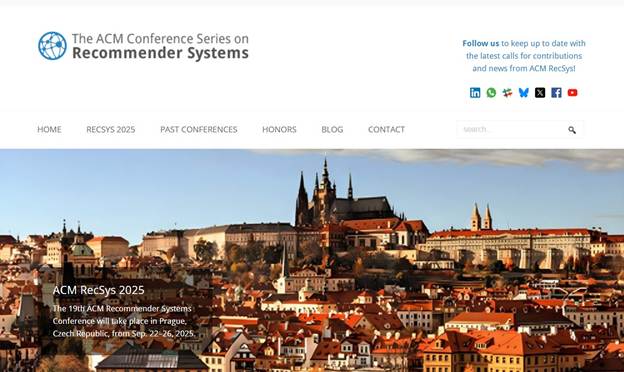
The ACM Conference on Recommender Systems (RecSys) 2025 took place in Prague, Czech Republic, from September 22–26, 2025. The event brought together researchers and practitioners from academia and industry to present their latest findings and explore new trends in building recommendation technologies.

This year, one of the most exciting themes was the growing overlap between natural language processing (NLP) and recommender systems. Large language models (LLMs), semantic clustering, and text-based personalization appeared everywhere, showing how recommender systems are now drawing heavily on computational linguistics. As someone who has been learning more about NLP myself, it is really cool to see how the research world is pushing these ideas forward.


Paper Highlights

A Language Model-Based Playlist Generation Recommender System

Paper Link

Relevance:
Uses language models to generate playlists by creating semantic clusters from text embeddings of playlist titles and track metadata. This directly applies NLP for thematic coherence and semantic similarity in music recommendations.

Abstract:
The title of a playlist often reflects an intended mood or theme, allowing creators to easily locate their content and enabling other users to discover music that matches specific situations and needs. This work presents a novel approach to playlist generation using language models to leverage the thematic coherence between a playlist title and its tracks. Our method consists in creating semantic clusters from text embeddings, followed by fine-tuning a transformer model on these thematic clusters. Playlists are then generated considering the cosine similarity scores between known and unknown titles and applying a voting mechanism. Performance evaluation, combining quantitative and qualitative metrics, demonstrates that using the playlist title as a seed provides useful recommendations, even in a zero-shot scenario.


An Off-Policy Learning Approach for Steering Sentence Generation towards Personalization

Paper Link

Relevance:
Focuses on off-policy learning to guide LLM-based sentence generation for personalized recommendations. Involves NLP tasks like controlled text generation and personalization via language model fine-tuning.

Abstract:
We study the problem of personalizing the output of a large language model (LLM) by training on logged bandit feedback (e.g., personalizing movie descriptions based on likes). While one may naively treat this as a standard off-policy contextual bandit problem, the large action space and the large parameter space make naive applications of off-policy learning (OPL) infeasible. We overcome this challenge by learning a prompt policy for a frozen LLM that has only a modest number of parameters. The proposed Direct Sentence Off-policy gradient (DSO) effectively propagates the gradient to the prompt policy space by leveraging the smoothness and overlap in the sentence space. Consequently, DSO substantially reduces variance while also suppressing bias. Empirical results on our newly established suite of benchmarks, called OfflinePrompts, demonstrate the effectiveness of the proposed approach in generating personalized descriptions for movie recommendations, particularly when the number of candidate prompts and reward noise are large.


Enhancing Sequential Recommender with Large Language Models for Joint Video and Comment Recommendation

Paper Link

Relevance:
Integrates LLMs to enhance sequential recommendations by processing video content and user comments. Relies on NLP for joint modeling of multimodal text (like comments) and semantic user preferences.

Abstract:
Nowadays, reading or writing comments on captivating videos has emerged as a critical part of the viewing experience on online video platforms. However, existing recommender systems primarily focus on users’ interaction behaviors with videos, neglecting comment content and interaction in user preference modeling. In this paper, we propose a novel recommendation approach called LSVCR that utilizes user interaction histories with both videos and comments to jointly perform personalized video and comment recommendation. Specifically, our approach comprises two key components: sequential recommendation (SR) model and supplemental large language model (LLM) recommender. The SR model functions as the primary recommendation backbone (retained in deployment) of our method for efficient user preference modeling. Concurrently, we employ a LLM as the supplemental recommender (discarded in deployment) to better capture underlying user preferences derived from heterogeneous interaction behaviors. In order to integrate the strengths of the SR model and the supplemental LLM recommender, we introduce a two-stage training paradigm. The first stage, personalized preference alignment, aims to align the preference representations from both components, thereby enhancing the semantics of the SR model. The second stage, recommendation-oriented fine-tuning, involves fine-tuning the alignment-enhanced SR model according to specific objectives. Extensive experiments in both video and comment recommendation tasks demonstrate the effectiveness of LSVCR. Moreover, online A/B testing on KuaiShou platform verifies the practical benefits of our approach. In particular, we attain a cumulative gain of 4.13% in comment watch time.


LLM-RecG: A Semantic Bias-Aware Framework for Zero-Shot Sequential Recommendation

Paper Link

Relevance:
Addresses domain semantic bias in LLMs for cross-domain recommendations using generalization losses to align item embeddings. Employs NLP techniques like pretrained representations and semantic alignment to mitigate vocabulary differences across domains.

Abstract:
Zero-shot cross-domain sequential recommendation (ZCDSR) enables predictions in unseen domains without additional training or fine-tuning, addressing the limitations of traditional models in sparse data environments. Recent advancements in large language models (LLMs) have significantly enhanced ZCDSR by facilitating cross-domain knowledge transfer through rich, pretrained representations. Despite this progress, domain semantic bias arising from differences in vocabulary and content focus between domains remains a persistent challenge, leading to misaligned item embeddings and reduced generalization across domains.

To address this, we propose a novel semantic bias-aware framework that enhances LLM-based ZCDSR by improving cross-domain alignment at both the item and sequential levels. At the item level, we introduce a generalization loss that aligns the embeddings of items across domains (inter-domain compactness), while preserving the unique characteristics of each item within its own domain (intra-domain diversity). This ensures that item embeddings can be transferred effectively between domains without collapsing into overly generic or uniform representations. At the sequential level, we develop a method to transfer user behavioral patterns by clustering source domain user sequences and applying attention-based aggregation during target domain inference. We dynamically adapt user embeddings to unseen domains, enabling effective zero-shot recommendations without requiring target-domain interactions.

Extensive experiments across multiple datasets and domains demonstrate that our framework significantly enhances the performance of sequential recommendation models on the ZCDSR task. By addressing domain bias and improving the transfer of sequential patterns, our method offers a scalable and robust solution for better knowledge transfer, enabling improved zero-shot recommendations across domains.


Trends Observed

These papers reflect a broader trend at RecSys 2025 toward hybrid NLP-RecSys approaches, with LLMs enabling better handling of textual side information (like reviews, titles, and comments) for cold-start problems and cross-domain generalization. This aligns with recent surveys on LLMs in recommender systems, which note improvements in semantic understanding over traditional embeddings.


Final Thoughts

As a high school student interested in computational linguistics, reading about these papers feels like peeking into the future. I used to think of recommender systems as black boxes that just show you more videos or songs you might like. But at RecSys 2025, it is clear the field is moving toward systems that actually “understand” language and context, not just click patterns.

For me, that is inspiring. It means the skills I am learning right now, from studying embeddings to experimenting with sentiment analysis, could actually be part of real-world systems that people use every day. It also shows how much crossover there is between disciplines. You can be into linguistics, AI, and even user experience design, and still find a place in recommender system research.

Seeing these studies also makes me think about the responsibility that comes with more powerful recommendation technology. If models are becoming better at predicting our tastes, we have to be careful about bias, fairness, and privacy. This is why conferences like RecSys are so valuable. They are a chance for researchers to share ideas, critique each other’s work, and build a better tech future together.

— Andrew

4,361 hits

Caring Machines, Centered Humans: Lessons from Ai4 2025

At Ai4 2025 (August 11–13, Las Vegas), two of the most influential voices in artificial intelligence expressed strikingly different visions for the future. Geoffrey Hinton, often called the “Godfather of AI,” suggested that AI should be designed with something like “maternal instincts.” He argued that as AI becomes smarter than humans, we cannot realistically control it through traditional dominance strategies. The only model we have of a less intelligent being guiding a more intelligent one is the relationship between a baby and its mother. A mother cares for her child not because she is weaker, but because she is built to protect and nurture. Hinton believes this kind of protective orientation is what could keep humanity safe in the long run.

Fei-Fei Li, sometimes called the “Godmother of AI,” offered a different perspective in a CNN interview. She disagrees with parental analogies for AI. Instead, she emphasizes designing human-centered AI, systems that uphold human dignity, promote agency, and avoid emotional metaphors that could mislead how we understand AI.

Summary Comparison of Views

When I first read about these contrasting views, I found myself agreeing with both in different ways. On one hand, Hinton’s maternal metaphor captures the seriousness of what could happen if superintelligence arrives sooner than many expect. If AI truly surpasses human intelligence, relying solely on control may fail. On the other hand, Li’s approach feels grounded and practical. She reminds us that the ethical choices we make today will set the trajectory for future systems.

The best answer may not lie in choosing between them, but in combining their strengths. I think about this as a layered model. The foundation should be Li’s human-centered AI: respect, fairness, transparency, and agency. On top of that we need what Hinton calls protective alignment. These would be structural safeguards that ensure highly intelligent systems still act in ways that preserve human well-being.

Hybrid Framework Diagram
Here is how I visualize this combination of perspectives: Li’s human-centered AI forms the core, while Hinton’s protective alignment provides the outer safeguard.

Practical Integration

  • Development Phase (Near-Term, Li):
    Apply human-centered AI frameworks to today’s large language models, robotics, and decision-support systems.
    Focus on privacy, bias reduction, explainability, and giving users agency over their interactions with AI.
  • Safety Research Phase (Mid- to Long-Term, Hinton):
    Begin embedding structural safeguards that mimic “caring instincts.”
    Example: AI systems with hard-coded prohibitions against harming humans, but reinforced by higher-order goals like proactively ensuring human thriving.
  • Governance and Oversight:
    Combine Li’s push for international, human-centered AI policy with Hinton’s insistence on global collaboration to avoid runaway dominance races.

In other words, AI should be designed to treat humanity as worth protecting, while being anchored in the principles of dignity.

As a high school student exploring AI and computational linguistics, I believe this hybrid vision is the most realistic path forward. It addresses the near-term challenges of fairness, transparency, and accountability while also preparing for the long-term risks of superintelligence. For me, this is not just an abstract debate. Thinking about how we embed values and safety into AI connects directly to my own interests in language models, hate speech detection, robotics, and how technology interacts with human society.

The future of AI is not predetermined. It will be shaped by the principles we choose now. By combining Hinton’s call for protective instincts with Li’s insistence on human-centered design, we have a chance to build AI that both cares for us and respects us.

For readers interested in the original coverage of this debate, see the CNN article here.

— Andrew

The AI Gap: How Socioeconomic Status Shapes Language Technology Use — A Perspective from Best Social Impact Paper at ACL 2025

The 63rd Annual Meeting of the Association for Computational Linguistics (ACL 2025) recently finished in Vienna, Austria from July 27 to August 1. The conference announced a few awards, one of which is Best Social Impact Paper. This award was given to two papers:

  1. AfriMed-QA: A Pan-African, Multi-Specialty, Medical Question-Answering Benchmark Dataset (by Charles Nimo et al.)
  2. The AI Gap: How Socioeconomic Status Affects Language Technology Interactions (by Elisa Bassignana, Amanda Cercas Curry, and Dirk Hovy).

In this blog post, I’ll talk about the second paper and share the findings from the paper and my thoughts on the topic. You can read the full paper here: https://aclanthology.org/2025.acl-long.914.pdf

What the Paper is About

This paper investigates how socioeconomic status (SES) influences interactions with language technologies, particularly large language models (LLMs) like ChatGPT, highlighting an emerging “AI Gap” that could exacerbate social inequalities. Drawing from the Technology Acceptance Model and prior work on digital divides, the authors argue that SES shapes technology adoption through factors like access, digital literacy, and linguistic habits, potentially biasing LLMs toward higher-SES patterns and underrepresenting lower-SES users.

Methods

The study surveys 1,000 English-speaking participants from the UK and US via Prolific, stratified by self-reported SES using the MacArthur scale (binned as low: 1-3, middle: 4-7, upper: 8-10). It collects sociodemographic data, usage patterns of language technologies (e.g., spell checkers, AI chatbots), and 6,482 real prompts from prior LLM interactions. Analysis includes statistical tests (e.g., chi-square for usage differences), linguistic metrics (e.g., prompt length, concreteness via Brysbaert et al.’s word ratings), topic modeling (using embeddings, UMAP, HDBSCAN, and GPT-4 for cluster descriptions), and markers of anthropomorphism (e.g., phatic expressions like “hi” and politeness markers like “thank you”).

Key Findings

  • Usage Patterns: Higher-SES individuals access more devices daily (e.g., laptops, smartwatches) and use LLMs more frequently (e.g., daily vs. rarely for lower SES). They employ LLMs for work/education (e.g., coding, data analysis, writing) and technical contexts, while lower-SES users favor entertainment, brainstorming, and general knowledge queries. Statistically significant differences exist in frequency (p < 0.001), contexts (p < 0.001), and tasks (p < 0.001).
  • Linguistic Differences in Prompts: Higher-SES prompts are shorter (avg. 18.4 words vs. 27.0 for low SES; p < 0.05) and more abstract (concreteness score: 2.57 vs. 2.66; p < 0.05). Lower-SES prompts show higher anthropomorphism (e.g., more phatic expressions) and concrete language. A bag-of-words classifier distinguishes SES groups (Macro-F1 39.25 vs. baseline 25.02).
  • Topics and Framing: Common topics (e.g., translation, mental health, medical advice, writing, text editing, finance, job, food) appear across groups, but framing varies—e.g., lower SES seeks debt reduction or low-skill jobs; higher SES focuses on investments, travel itineraries, or inclusivity. About 45% of prompts resemble search-engine queries, suggesting LLMs are replacing traditional searches.
  • User Perceptions: Trends indicate lower-SES users anthropomorphize more (e.g., metaphorical verbs like “ask”), while higher-SES use jargon (e.g., “generate”), though not statistically significant.

Discussion and Implications

The findings underscore how SES stratifies LLM use, with higher-SES benefiting more in professional/educational contexts, potentially widening inequalities as LLMs optimize for their patterns. Benchmarks may overlook lower-SES styles, leading to biases. The authors advocate the development of inclusive NLP technologies to accommodate different SES needs and habitus and mitigate the existing AI Gap.

Limitations and Ethics

Limited to Prolific crowdworkers (skewed middle/low SES, tech-savvy), subjective SES measures, and potential LLM-generated responses. Ethical compliance includes GDPR anonymity, opt-outs, and fair compensation (£9/hour).

Overall, the paper reveals SES-driven disparities in technology interactions, urging NLP development to address linguistic and habitual differences for equitable access and reduced digital divides.

My Takeaway

As a high school student who spends a lot of time thinking about fairness in AI, I find this paper important because it reminds us that bias is not just about language or culture, it can also be tied to socioeconomic status. This is something I had not thought much about before. If AI systems are trained mostly on data from higher SES groups, they might misunderstand or underperform for people from lower SES backgrounds. That could affect how well people can use AI for education, job searching, or even just getting accurate information online.

For me, the takeaway is that AI researchers need to test their models with SES diversity in mind, just like they do with gender or language diversity. And as someone interested in computational linguistics, it is inspiring to see that work like this is getting recognized with awards at ACL.

— Andrew

Humanoid Robot Forum 2025: Where Industrial Innovation Takes Center Stage

If you’re as interested in the future of robotics as I am, here’s an event you’ll want to keep an eye on. The Humanoid Robot Forum 2025 is happening on September 23, 2025, in Seattle (my city), Washington. Organized by the Association for Advancing Automation (A3), this one-day event brings together experts from the robotics and AI industries to explore how humanoid robots are being developed and deployed in real-world settings.

What makes this event exciting to me is that it focuses not just on hardware, but also on how technologies like AI and simulation are shaping the next generation of human-like robots. One of the keynotes I’m especially looking forward to is from Amit Goel, Head of Robotics Ecosystem at NVIDIA. His talk, “Advancing Humanoid Robotics Through Generative AI and Simulation,” will dive into how generative AI can help design, train, and test robot behaviors in simulated environments before deploying them in the real world. As someone who’s been exploring AI and NLP through my own projects, this intersection of AI and robotics is something I’m eager to learn more about.

The full agenda includes sessions and speakers from:

  • Diligent
  • Apptronik
  • Agility Robotics
  • PSYONIC
  • GXO
  • Association for Advancing Automation (A3)
  • Boston Dynamics
  • UCSD Advanced Robotics and Controls Lab
  • WiBotic
  • Cobot
  • NVIDIA
  • Cambridge Consultants
  • Toyota Research Institute
  • Sanctuary AI
  • True Ventures

Topics will include scaling up robotic hardware, AI-driven perception and control, power management, investment trends, and more. For anyone curious about how humanoid robots might start appearing in warehouses, hospitals, or even homes, this forum gives a front-row seat to what’s happening in the field.

Even though I won’t be attending in person (I’ve got school, college apps, and robotics season keeping me busy), I’ll definitely be keeping an eye out for takeaways and speaker highlights.

You can check out the full agenda and register for the event here:
👉 Humanoid Robot Forum 2025

— Andrew

WAIC 2025: What Geoffrey Hinton’s “Tiger” Warning Taught Me About AI’s Future

At the end of July (7/26 – 7/28), Shanghai hosted the 2025 World Artificial Intelligence Conference (WAIC), drawing over 1,200 participants from more than 40 countries. Even though I wasn’t there, I followed the conference closely, especially the keynote from Geoffrey Hinton, the so-called “Godfather of AI.” His message? AI is advancing faster than we expect, and we need global cooperation to make sure it stays aligned with human values.

Hinton’s talk was historic. It was his first public appearance in China, and he even stood throughout his address despite back pain, which was noted by local media. One quote really stuck with me: “Humans have grown accustomed to being the most intelligent species in the world – what if that’s no longer the case?” That’s a big question, and as someone who’s diving deeper into computational linguistics and large language models, I felt both amazed and a little uneasy.

His warning compared superintelligent AI to a tiger we’re raising as a pet. If we’re not careful, he said, “the tiger” might one day turn on us. The point wasn’t to scare everyone, but to highlight why we can’t rely on simply pulling the plug if AI systems surpass human intelligence. Hinton believes we need to train AI to be good from the beginning because shutting it down later might not be an option.

WAIC 2025 wasn’t all doom and gloom though. Hinton also talked about the huge potential of AI to accelerate science. For example, he highlighted DeepMind’s AlphaFold as a breakthrough that solved a major biology challenge, predicting protein structures. That shows how powerful AI can be when guided properly.

What stood out the most was the recurring theme of cooperation. Hinton and others, like former Google CEO Eric Schmidt, emphasized the need for global partnerships on AI safety and ethics. Hinton even signed the “Shanghai AI Safety Consensus” with other experts to support international collaboration. The message was clear: no single country can or should handle AI’s future alone.

As a high school student passionate about AI and language, I’m still learning how these pieces fit together. But events like WAIC remind me that the future of AI isn’t just about building smarter systems, it’s also about making sure they work for everyone.

For those interested, here’s a more detailed summary of Hinton’s latest speech: Pandaily Report on WAIC 2025

You can also explore the official WAIC website here: https://www.worldaic.com.cn/

— Andrew

ACL 2025 New Theme Track: Generalization in NLP Models

The 63rd Annual Meeting of the Association for Computational Linguistics (ACL 2025) will be happening in Vienna, Austria from July 27 to August 1. I won’t be attending in person, but as someone planning to study and do research in computational linguistics and NLP in college, I’ve been following the conference closely to keep up with the latest trends.

One exciting thing about this year’s ACL is its new theme track: Generalization of NLP Models. According to the official announcement:

“Following the success of the ACL 2020–2024 Theme tracks, we are happy to announce that ACL 2025 will have a new theme with the goal of reflecting and stimulating discussion about the current state of development of the field of NLP.

Generalization is crucial for ensuring that models behave robustly, reliably, and fairly when making predictions on data different from their training data. Achieving good generalization is critically important for models used in real-world applications, as they should emulate human-like behavior. Humans are known for their ability to generalize well, and models should aspire to this standard.

The theme track invites empirical and theoretical research and position and survey papers reflecting on the Generalization of NLP Models. The possible topics of discussion include (but are not limited to) the following:

  • How can we enhance the generalization of NLP models across various dimensions—compositional, structural, cross-task, cross-lingual, cross-domain, and robustness?
  • What factors affect the generalization of NLP models?
  • What are the most effective methods for evaluating the generalization capabilities of NLP models?
  • While Large Language Models (LLMs) significantly enhance the generalization of NLP models, what are the key limitations of LLMs in this regard?

The theme track submissions can be either long or short. We anticipate having a special session for this theme at the conference and a Thematic Paper Award in addition to other categories of awards.”

This year’s focus on generalization really highlights where the field is going—toward more robust, ethical, and real-world-ready NLP systems. It’s not just about making cool models anymore, but about making sure they work well across different languages, cultures, and use cases.

If you’re into reading papers like I am, especially ones that dig into how NLP systems can perform reliably on new or unexpected inputs, this theme track will be full of insights. I’m looking forward to checking out the accepted papers when they’re released.

You can read more at the official conference page: ACL 2025 Theme Track Announcement

— Andrew

Attending SCiL 2025: My First In-Person Computational Linguistics Conference at the University of Oregon

This July, I had the amazing opportunity to attend the 2025 Society for Computation in Linguistics (SCiL) conference, held at the University of Oregon in Eugene from July 18 to 20. This wasn’t just my first academic conference in person. It was also my first time attending a conference where I was (surprisingly) the only high school student in the room.


Road Trip to Eugene and My Badge Moment

My family and I made the drive from Seattle to Eugene, a nearly 300-mile road trip along I-5. I was super excited (and a little nervous) to be attending a professional conference alongside professors, postdocs, and graduate students.

When I checked in, I got my conference badge and immediately noticed something funny. My badge just said “Andrew Li,” with no school or organization listed, while everyone else had theirs printed with their university or research institute. I guess Redmond High School isn’t in their system yet!


The Crowd: Grad Students, Professors, and Me

The SCiL crowd was mostly made up of college professors and graduate students. At first, I felt a little out of place sitting in rooms full of experts discussing topics in areas such as pragmatics and large language models. But once the sessions started, I realized that even as a student just starting out in the field, there was so much I could follow and even more that I wanted to learn.

The conference covered a wide range of topics, all tied together by a focus on computational modeling in linguistics. You can find the full conference schedule here.

I was especially drawn to Dr. Malihe Alikhani‘s keynote presentation “Theory of Mind in Generative Models: From Uncertainty to Shared Meaning“. Her talk explored how generative models can effectively facilitate communicative grounding by incorporating theory of mind alongside uncertainty and human feedback. What stood out to me most was the idea that positive friction can be intentionally built into conversational systems so that it encourages contemplative thinking such as reflection on uncertain assumptions by both the users and AI systems. I was also fascinated by how generative
models embody core mechanisms of pragmatic reasoning, offering linguists and cognitive
scientists both methodological challenges and opportunities to question how computational
systems reflect and shape our understanding of meaning and interaction.


Networking and New Connections

While I didn’t get the chance to meet Prof. Jonathan Dunn in person as planned (he’s teaching “Computational Construction Grammar” at the LSA 2025 Summer Institute from July 24 through August 7 and won’t arrive until July 23), I still made some great new connections.

One of them was Andrew Liu, a graduate student at the University of Toronto. We chatted about his project, “Similarity, Transformation, and the Newly Found Invariance of Influence Functions,” which he’s presenting during the poster session. He was super friendly and shared valuable advice about studying and doing research in computational linguistics and NLP. Here’s his LinkedIn profile if you’d like to check out his work.

Talking with grad students made me realize how wide the field of computational linguistics really is. Everyone had a different background — some came from linguistics, others from computer science or cognitive science — but they were all united by a shared passion for understanding language through computation.


Final Thoughts

Attending SCiL 2025 was eye-opening. Even though I was probably the youngest person there, I felt inspired, welcomed, and challenged in the best way. It confirmed my passion for computational linguistics /NLP and reminded me how much more I want to learn.

If you’re a high school student curious about computational linguistics/NLP, don’t be intimidated by professional conferences. Dive in, listen closely, ask questions, and you might be surprised by how much you take away.

— Andrew

Blog at WordPress.com.

Up ↑