Summary: “Large Language Models Are Improving Exponentially”

I recently read an article on IEEE Spectrum titled “Large Language Models Are Improving Exponentially”. Here is a summary of its key points.


Benchmarking LLM Performance

Benchmarking large language models (LLMs) is challenging because their main goal is to produce text indistinguishable from human writing, which doesn’t always correlate with traditional processor performance metrics. However, it remains important to measure their progress to understand how much better LLMs are becoming over time and to estimate when they might complete substantial tasks independently.


METR’s Findings on Exponential Improvement

Researchers at Model Evaluation & Threat Research (METR) in Berkeley, California, published a paper in March called Measuring AI Ability to Complete Long Tasks. They concluded that:

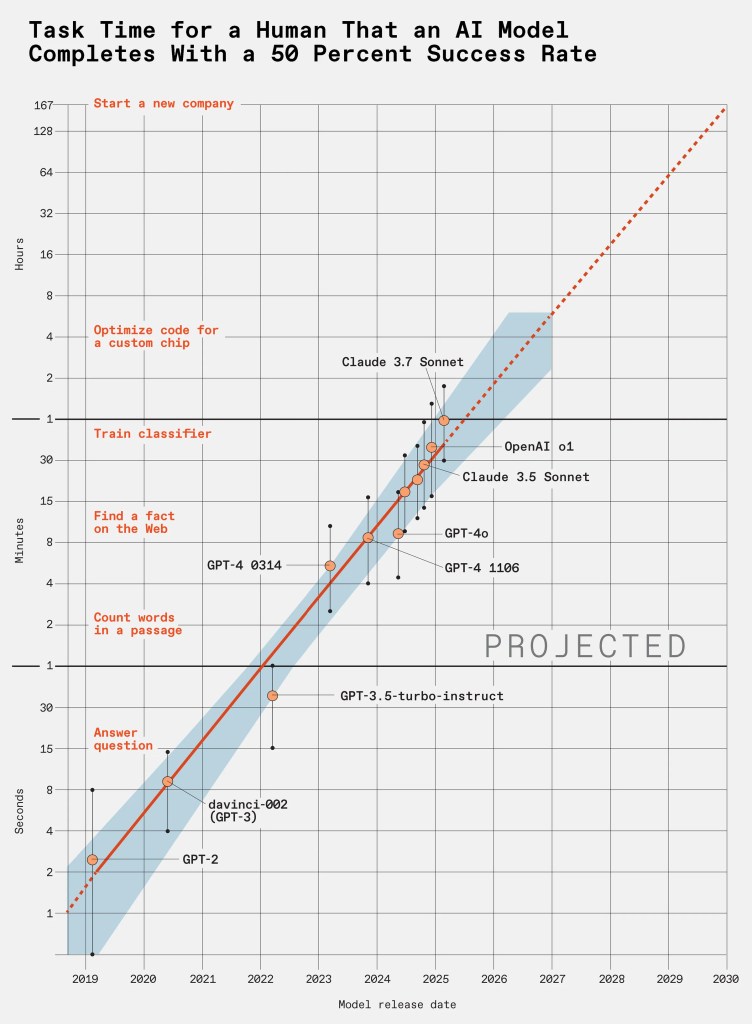
  • The capabilities of key LLMs are doubling every seven months.
  • By 2030, the most advanced LLMs could complete, with 50 percent reliability, a software-based task that would take humans a full month of 40-hour workweeks.
  • These LLMs might accomplish such tasks much faster than humans, possibly within days or even hours.

Potential Tasks by 2030

Tasks that LLMs might be able to perform by 2030 include:

  • Starting up a company
  • Writing a novel
  • Greatly improving an existing LLM

According to AI researcher Zach Stein-Perlman, such capabilities would come with enormous stakes, involving both potential benefits and significant risks.


The Task-Completion Time Horizon Metric

At the core of METR’s work is a metric called “task-completion time horizon.” It measures the time it would take human programmers to complete a task that an LLM can complete with a specified reliability, such as 50 percent.

Their plots (see graphs below) show:

  • Exponential growth in LLM capabilities with a doubling period of around seven months (Graph at the top).
  • Tasks that are “messier” or more similar to real-world scenarios remain more challenging for LLMs (Graph at the bottom).

Caveats About Growth and Risks

While these results raise concerns about rapid AI advancement, METR researcher Megan Kinniment noted that:

  • Rapid acceleration does not necessarily result in “massively explosive growth.”
  • Progress could be slowed by factors such as hardware or robotics bottlenecks, even if AI systems become very advanced.

Final Summary

Overall, the article emphasizes that LLMs are improving exponentially, potentially enabling them to handle complex, month-long human tasks by 2030. This progress comes with significant benefits and risks, and its trajectory may depend on external factors like hardware limitations.

You can read the full article here.

— Andrew

Speeding Up AI for Everyone: The PaPaformer Model Making Language Tech Work on Phones and Low-Power Devices

AI has become more capable than ever, but many of the most advanced tools still require massive cloud servers to run. That means if you want ChatGPT-level performance, you usually need a reliable internet connection and a lot of computing power behind the scenes. But what if you could have that kind of AI right on your phone, even without Wi‑Fi?

That’s where the PaPaformer model comes in.

What is the PaPaformer Model?
PaPaformer is a new AI architecture developed to train large language models more efficiently and make them small enough to run smoothly on low-power devices like smartphones, tablets, or even embedded systems. You can read more about it in the original paper here: PaPaformer: Language Model from Pre-trained Parallel Paths.

Unlike most large models today that require powerful cloud servers to process requests, PaPaformer is designed so the model can be stored and run directly on your device. This means you can use advanced language technology without a constant internet connection. It also helps protect privacy, since your data stays local instead of being sent to the cloud for processing.

Why It Matters
By making AI lighter and more portable, PaPaformer could bring powerful language tools to more people around the world, including those with limited internet access or older devices. It could also make AI faster to respond, since it does not have to constantly send data back and forth to the cloud.

Examples in Action
Imagine using ChatGPT-style features on a budget smartphone in a remote area. With most current apps, like the regular ChatGPT app, you still need a strong internet connection because the AI runs on servers, not your device. But with a PaPaformer-powered tool, the AI would actually run locally, meaning you could:

  • Translate between languages instantly, even without Wi‑Fi
  • Use a speech-to-text tool for endangered languages that works entirely on your device
  • Let teachers translate lessons in real time for students in rural schools without relying on an internet connection
  • Help students write essays in multiple languages privately, without sending drafts to a remote server

This offline capability is the big difference. It is not just accessing AI through the cloud, it is carrying the AI with you wherever you go.

Looking Ahead
If PaPaformer and similar approaches keep improving, we could see a future where advanced AI is available to anyone, anywhere, without needing expensive devices or constant internet access. For someone like me, interested in computational linguistics, this could also open up new possibilities for preserving languages, creating translation tools, and making language technology more inclusive worldwide.

— Andrew

How NLP Helps Robots Handle Interruptions: A Summary of JHU Research

I recently came across an awesome study from Johns Hopkins University describing how computational linguistics and NLP can make robots better conversational partners by teaching them how to handle interruptions, a feature that feels basic for humans but is surprisingly hard for machines.


What the Study Found

Researchers trained a social robot powered by a large language model (LLM) to manage real-time interruptions based on speaker intent. They categorized interruptions into four types: Agreement, Assistance, Clarification, and Disruption.

By analyzing human conversations from interviews to informal discussions, they designed strategies tailored to each interruption type. For example:

  • If someone agrees or helps, the robot pauses, nods, and resumes speaking.
  • When someone asks for clarification, the robot explains and continues.
  • For disruptive interruptions, the robot can either hold the floor to summarize its remaining points before yielding to the human user, or it can stop talking immediately.

How NLP Powers This System

The robot uses an LLM to:

  1. Detect overlapping speech
  2. Classify the interrupter’s intent
  3. Select the appropriate response strategy

In tests involving tasks and conversations, the system correctly interpreted interruptions about 89% of the time and responded appropriately 93.7% of the time.


Why This Matters in NLP and Computational Linguistics

This work highlights how computational linguistics and NLP are essential to human-robot interaction.

  • NLP does more than generate responses; it helps robots understand nuance, context, and intent.
  • Developing systems like this requires understanding pause cues, intonation, and conversational flow, all core to computational linguistics.
  • It shows how multimodal AI, combining language with behavior, can enable more natural and effective interactions.

What I Found Most Interesting

The researchers noted that users didn’t like when the robot “held the floor” too long during disruptive interruptions. It reminded me how pragmatic context matters. Just like people expect some rules in human conversations, robots need these conversational skills too.


Looking Ahead

This research expands what NLP can do in real-world settings like healthcare, education, and social assistants. For someone like me who loves robots and language, it shows how computational linguistics helps build smarter, more human-friendly AI systems.

If you want to dive deeper, check out the full report from Johns Hopkins:
Talking robots learn to manage human interruptions

— Andrew

How Dragon Years Shape Marriages and Births: Evidence from Statistical Analysis

Recently, I came across an interesting article published in the journal Significance, an official magazine of the Royal Statistical Society, the American Statistical Association, and the Statistical Society of Australia. Being a Chinese American, I’m always interested in learning about Chinese culture, in addition to the language. This article explored something I’ve heard a lot from my family but never thought about deeply: Do dragon years really make people get married or have babies more?


What Is This All About?

In Chinese astrology, each lunar year is assigned one of 12 animals. The dragon is considered the most powerful and auspicious. Growing up, I often heard my relatives say it’s best to get married or have children in a dragon year because it brings luck and prosperity.

The article shared the author’s personal story about how his Aunty Li would always nag him about getting married. But in the Year of the Dragon (2024), she suddenly stopped. Why? Because planning a wedding or having a baby in a dragon year takes time, and it was already too late for him to give her a “dragon wedding” or “dragon baby.” This story made me smile because it reminded me of my own family gatherings.


What Did the Research Find?

Researchers looked at birth and marriage data from 1970 to 2023 in six countries: Singapore, China, Malaysia, the UK, Kenya, and Mexico. Here are some highlights that stood out to me:

  • In Singapore, there was a strong positive dragon effect. The fertility rate increased by about 0.17 children per woman in dragon years, which is a noticeable boost.
  • In China, surprisingly, there wasn’t a big dragon effect overall. The researchers suggested this could be because of the one-child policy (1979–2015). Families couldn’t plan for a second dragon baby even if they wanted to.
  • In Malaysia, there was a small positive effect, but it wasn’t as strong as Singapore’s.
  • In countries with tiny Chinese populations (UK, Kenya, Mexico), there was no real dragon effect.
  • Snake years, which follow dragon years and are considered less lucky, showed slightly negative effects on fertility, though these were small and not consistent across countries.

What About Marriage?

The study also looked at marriage rates among ethnic Chinese in Singapore. They expected an increase in dragon years, but the results were mixed. There was no clear pattern, and some dragon years actually had fewer marriages. So, while having a dragon baby seems to matter, a dragon wedding might not be as big of a deal in the data (even though aunties still care a lot about it!).


Why Does This Matter?

For me, reading this was a cool reminder of how cultural beliefs can actually show up in real data. It also shows how statistical models can help us separate superstition from reality. In Singapore, the effect was strong enough that even the prime minister encouraged citizens to “add a little dragon” in his Lunar New Year speech.

At the same time, the study reminded me that traditions, culture, and policies (like China’s one-child policy) all interact to shape what people decide to do with their lives.


Final Thoughts

As a student interested in computational linguistics and social data, I find studies like this inspiring. They connect language, culture, demographics, and data analysis in a meaningful way. Plus, it makes me think about how traditions continue to shape decisions, even in modern societies.

I wonder if my parents also hoped I would be a dragon baby. (Spoiler: I’m not, but at least I wasn’t born in the Year of the Snake either!)

If you’re curious about Chinese culture, statistics, or demographic trends, I highly recommend reading the full article here (if your school has access). Let me know if you want a follow-up post explaining how the statistical model in the paper worked.

— Andrew

I-Language vs. E-Language: What Do They Mean in Computational Linguistics?

In the summer of 2025, I started working on a computational linguistics research project using Twitch data under the guidance of Dr. Sidney Wong, a Computational Sociolinguist. As someone who is still pretty new to this field, I was mainly focused on learning how to conduct literature reviews, help narrow down research topics, clean data, build models, and extract insights.

One day, Dr. Wong suggested I look into the concept of I-language vs. E-language from theoretical linguistics. At first, I wasn’t sure why this mattered. I thought, Isn’t language just… language?

But as I read more, I realized that understanding this distinction changes how we think about language data and what we’re actually modeling when we work with NLP.

In this post, I want to share what I’ve learned about I-language and E-language, and why this distinction is important for computational linguistics research.


What Is I-Language?

I-language stands for “internal language.” This idea was proposed by Noam Chomsky, who argued that language is fundamentally a mental system. I-language refers to the internal, cognitive grammar that allows us to generate and understand sentences. It is about:

  • The unconscious rules and structures stored in our minds
  • Our innate capacity for language
  • The mental system that explains why we can produce and interpret sentences we’ve never heard before

For example, if I say, “The cat sat on the mat,” I-language is the system in my brain that knows the sentence is grammatically correct and what it means, even though I may never have said that exact sentence before.

I-language focuses on competence (what we know about our language) rather than performance (how we actually use it in real life).


What Is E-Language?

E-language stands for “external language.” This is the language we actually hear and see in the world, such as:

  • Conversations between Twitch streamers and their viewers
  • Tweets, Reddit posts, books, and articles
  • Any linguistic data that exists outside the mind

E-language is about observable language use. It includes everything from polished academic writing to messy chat messages filled with abbreviations, typos, and slang.

Instead of asking, “What knowledge do speakers have about their language?”, E-language focuses on, “What do speakers actually produce in practice?”


Why Does This Matter for Computational Linguistics?

When it comes to computational linguistics and NLP, this distinction affects:

1. What We Model

  • I-language-focused research tries to model the underlying grammatical rules and mental representations. For example, building a parser that captures syntax structures based on linguistic theory.
  • E-language-focused research uses real-world data to build models that predict or generate language based on patterns, regardless of theoretical grammar. For example, training a neural network on millions of Twitch comments to generate chat responses.

2. Research Goals

If your goal is to understand how humans process and represent language cognitively, you’re leaning towards I-language research. This includes computational psycholinguistics, cognitive modeling, and formal grammar induction.

If your goal is to build practical NLP systems for tasks like translation, summarization, or sentiment analysis, you’re focusing on E-language. These projects care about performance and usefulness, even if the model doesn’t match linguistic theory.


3. How Models Are Evaluated

I-language models are evaluated based on how well they align with linguistic theory or native speaker intuitions about grammaticality.

E-language models are evaluated using performance metrics, such as accuracy, BLEU scores, or perplexity, based on how well they handle real-world data.


My Thoughts as a Beginner

When Dr. Wong first told me about this distinction, I thought it was purely theoretical. But now, while working with Twitch data, I see the importance of both views.

For example:

  • If I want to study how syntax structures vary in Twitch chats, I need to think in terms of I-language to analyze grammar.
  • If I want to build an NLP model that generates Twitch-style messages, I need to focus on E-language to capture real-world usage patterns.

Neither approach is better than the other. They just answer different types of questions. I-language is about why language works the way it does, while E-language is about how language is actually used in the world.


Final Thoughts

Understanding I-language vs. E-language helps me remember that language isn’t just data for machine learning models. It’s a human system with deep cognitive and social layers. Computational linguistics becomes much more meaningful when we consider both perspectives: What does the data tell us? and What does it reveal about how humans think and communicate?

If you’re also just starting out in this field, I hope this post helps you see why these theoretical concepts matter for practical NLP and AI work. Let me know if you want a follow-up post about other foundational linguistics ideas for computational research.

— Andrew

What Is Computational Linguistics (and How Is It Different from NLP)?

When I first got interested in this field, I kept seeing the terms computational linguistics and natural language processing (NLP) used almost interchangeably. At first, I thought they were the same thing. By delving deeper through reading papers, taking courses, and conducting research, I realized that although they overlap significantly, they are not entirely identical.

So in this post, I want to explain the difference (and connection) between computational linguistics and NLP from the perspective of a high school student who’s just getting started, but really interested in understanding both the language and the tech behind today’s AI systems.


So, what is computational linguistics?

Computational linguistics is the science of using computers to understand and model human language. It’s rooted in linguistics, the study of how language works, and applies computational methods to test linguistic theories, analyze language structure, or build tools like parsers and grammar analyzers.

It’s a field that sits at the intersection of computer science and linguistics. Think syntax trees, morphology, phonology, semantics, and using code to work with all of those.

For example, in computational linguistics, you might:

  • Use code to analyze sentence structure in different languages
  • Create models that explain how children learn grammar rules
  • Explore how prosody (intonation and stress) changes meaning in speech
  • Study how regional dialects appear in online chat platforms like Twitch

In other words, computational linguistics is often about understanding language (how it’s structured, how it varies, and how we can model it with computers).


Then what is NLP?

Natural language processing (NLP) is a subfield of AI and computer science that focuses on building systems that can process and generate human language. It’s more application-focused. If you’ve used tools like ChatGPT, Google Translate, Siri, or even grammar checkers, you’ve seen NLP in action.

While computational linguistics asks, “How does language work, and how can we model it?”, NLP tends to ask, “How can we build systems that understand or generate language usefully?”

Examples of NLP tasks:

  • Sentiment analysis (e.g., labeling text as positive, negative, or neutral)
  • Machine translation
  • Named entity recognition (e.g., tagging names, places, dates)
  • Text summarization or question answering

In many cases, NLP researchers care more about whether a system works than whether it matches a formal linguistic theory. That doesn’t mean theory doesn’t matter, but the focus is more on performance and results.


So, what’s the difference?

The line between the two fields can get blurry (and many people work in both), but here’s how I think of it:

Computational LinguisticsNLP
Rooted in linguisticsRooted in computer science and AI
Focused on explaining and modeling languageFocused on building tools and systems
Often theoretical or data-driven linguisticsOften engineering-focused and performance-driven
Examples: parsing syntax, studying morphologyExamples: sentiment analysis, machine translation

Think of computational linguistics as the science of language and NLP as the engineering side of language technology.


Why this matters to me

As someone who’s really interested in computational linguistics, I find myself drawn to the linguistic side of things, like how language varies, how meaning is structured, and how AI models sometimes get things subtly wrong because they don’t “understand” language the way humans do.

At the same time, I still explore NLP, especially when working on applied projects like sentiment analysis or topic modeling. I think having a strong foundation in linguistics makes me a better NLP researcher (or student), because I’m more aware of the complexity and nuance of language.


Final thoughts

If you’re just getting started, you don’t have to pick one or the other. Read papers from both fields. Try projects that help you learn both theory and application. Over time, you’ll probably find yourself leaning more toward one, but having experience in both will only help.

I’m still learning, and I’m excited to keep going deeper into both sides. If you’re interested too, let me know! I’m always up for sharing reading lists, courses, or just thoughts on cool research.

— Andrew


SCiL vs. ACL: What’s the Difference? (A Beginner’s Take from a High School Student)

As a high school student just starting to explore computational linguistics, I remember being confused by two organizations: SCiL (Society for Computation in Linguistics) and ACL (Association for Computational Linguistics). They both focus on language and computers, so at first, I assumed they were basically the same thing.

It wasn’t until recently that I realized they are actually two different academic communities. Each has its own focus, audience, and style of research. I’ve had the chance to engage with both, which helped me understand how they are connected and how they differ.

Earlier this year, I had the opportunity to co-author a paper that was accepted to a NAACL 2025 workshop (May 3–4). NAACL stands for the North American Chapter of the Association for Computational Linguistics. It is a regional chapter that serves researchers in the United States, Canada, and Mexico. NAACL follows ACL’s mission and guidelines but focuses on more local events and contributions.

This summer, I will be participating in SCiL 2025 (July 18–19), where I hope to meet researchers and learn more about how computational models are used to study language structure and cognition. Getting involved with both events helped me better understand what makes SCiL and ACL unique, so I wanted to share what I’ve learned for other students who might also be starting out.

SCiL and ACL: Same Field, Different Focus

Both SCiL and ACL are academic communities interested in studying human language using computational methods. However, they focus on different kinds of questions and attract different types of researchers.

Here’s how I would explain the difference.

SCiL (Society for Computation in Linguistics)

SCiL is more focused on using computational tools to support linguistic theory and cognitive science. Researchers here are often interested in how language works at a deeper level, including areas like syntax, semantics, and phonology.

The community is smaller and includes people from different disciplines like linguistics, psychology, and cognitive science. You are likely to see topics such as:

  • Computational models of language processing
  • Formal grammars and linguistic structure
  • Psycholinguistics and cognitive modeling
  • Theoretical syntax and semantics

If you are interested in how humans produce and understand language, and how computers can help us model that process, SCiL might be a great place to start.

ACL (Association for Computational Linguistics)

ACL has a broader and more applied focus. It is known for its work in natural language processing (NLP), artificial intelligence, and machine learning. The research tends to focus on building tools and systems that can actually use human language in practical ways.

The community is much larger and includes researchers from both academia and major tech companies like Google, OpenAI, Meta, and Microsoft. You will see topics such as:

  • Language models like GPT, BERT, and LLaMA
  • Machine translation and text summarization
  • Speech recognition and sentiment analysis
  • NLP benchmarks and evaluation methods

If you want to build or study real-world AI systems that use language, ACL is the place where a lot of that cutting-edge research is happening.

Which One Should You Explore First?

It really depends on what excites you most.

If you are curious about how language works in the brain or how to use computational tools to test theories of language, SCiL is a great choice. It is more theory-driven and focused on cognitive and linguistic insights.

If you are more interested in building AI systems, analyzing large datasets, or applying machine learning to text and speech, then ACL might be a better fit. It is more application-oriented and connected to the latest developments in NLP.

They both fall under the larger field of computational linguistics, but they come at it from different angles. SCiL is more linguistics-first, while ACL is more NLP-first.

Final Thoughts

I am still early in my journey, but understanding the difference between SCiL and ACL has already helped me navigate the field better. Each community asks different questions, uses different methods, and solves different problems, but both are helping to push the boundaries of how we understand and work with language.

I am looking forward to attending SCiL 2025 this summer, and I will definitely write about that experience afterward. In the meantime, I hope this post helps other students who are just starting out and wondering where to begin.

— Andrew

A Book That Expanded My Perspective on NLP: Natural Language Processing for Corpus Linguistics by Jonathan Dunn

Book Link: https://doi.org/10.1017/9781009070447

As I dive deeper into the fascinating world of Natural Language Processing (NLP), I often come across resources that reshape my understanding of the field. One such recent discovery is Jonathan Dunn’s Natural Language Processing for Corpus Linguistics. This book, a part of the Elements in Corpus Linguistics series by Cambridge University Press, stands out for its seamless integration of computational methods with traditional linguistic analysis.

A Quick Overview

The book serves as a guide to applying NLP techniques to corpus linguistics, especially in dealing with large-scale corpora that are beyond the scope of traditional manual analysis. It discusses how models like text classification and text similarity can help address linguistic problems such as categorization (e.g., identifying part-of-speech tags) and comparison (e.g., measuring stylistic similarities between authors).

What I found particularly intriguing is its structure, which is built around five compelling case studies:

  1. Corpus-Based Sociolinguistics: Exploring geographic and social variations in language use.
  2. Corpus Stylistics: Understanding authorship through stylistic differences in texts.
  3. Usage-Based Grammar: Analyzing syntax and semantics via computational models.
  4. Multilingualism Online: Investigating underrepresented languages in digital spaces.
  5. Socioeconomic Indicators: Applying corpus analysis to non-linguistic fields like politics and sentiment in customer reviews.

The book is as much a practical resource as it is theoretical. Accompanied by Python notebooks and a stand-alone Python package, it provides hands-on tools to implement the discussed methods—a feature that makes it especially appealing to readers with a technical bent.

A Personal Connection

My journey with this book is a bit more personal. While exploring NLP, I had the chance to meet Jonathan Dunn, who shared invaluable insights about this field. One of his students, Sidney Wong, recommended this book to me as a starting point for understanding how computational methods can expand corpus linguistics. It has since become a cornerstone of my learning in this area.

What Makes It Unique

Two aspects of Dunn’s book particularly resonated with me:

  1. Ethical Considerations: As corpus sizes grow, so do the ethical dilemmas associated with their use. From privacy issues to biases in computational models, the book doesn’t shy away from discussing the darker side of large-scale text analysis. This balance between innovation and responsibility is a critical takeaway for anyone venturing into NLP.
  2. Interdisciplinary Approach: Whether you’re a linguist looking to incorporate computational methods or a computer scientist aiming to understand linguistic principles, this book bridges the gap between the two disciplines beautifully. It encourages a collaborative perspective, which is essential in fields as expansive as NLP and corpus linguistics.

Who Should Read It?

If you’re a student, researcher, or practitioner with an interest in exploring how NLP can scale linguistic analysis, this book is for you. Its accessibility makes it suitable for beginners, while the advanced discussions and hands-on code offer plenty for seasoned professionals to learn from.

For me, Natural Language Processing for Corpus Linguistics isn’t just a book—it’s a toolkit, a mentor, and an inspiration rolled into one. As I continue my journey in NLP, I find myself revisiting its chapters for insights and ideas.

The World of Kaggle

Sorry for taking so long to write another blog post! I have been busy with finishing up and starting the new season of Vex Robotics, High Stakes. For more information, you can watch the game reveal video on YouTube. Link: https://www.youtube.com/watch?v=Sx6HJSpopeQ

So, what is Kaggle? Kaggle is a popular online platform for data science and machine learning enthusiasts to practice and enhance their skills. It offers a variety of resources, including datasets, notebooks, and learning tutorials. One of the key features of Kaggle is its competitions, which are hosted by companies and research institutions. These competitions challenge participants to solve real-world problems using data science and machine learning techniques. Participants can work individually or in teams to create models and submit their solutions. Competitions often come with monetary prizes and recognition, providing valuable opportunities for learning, networking, and career advancement in the data science community.
Over the past few months, I have been competing in various competitions and, as you might find in my Linguistics courses listed in this blog, I have taken some of Kaggle’s courses. If you would like to see some of my work, you can visit me at my Kaggle profile.

What Makes Kaggle So Interesting?

To me, Kaggle serves as a way to test my knowledge and skills in machine learning and data processing. These topics are key in the neural network and artificial intelligence side of Computational Linguistics. Though I am not in it for the prizes, I still find joy in seeing myself progress on the public leaderboard and observing how my shared notebooks can foster a community where like-minded people can share questions or advice. This is what I enjoy about Kaggle—the community and its competitive yet supportive atmosphere that allows people to learn.
Kaggle competitions are particularly valuable because they provide real-world datasets that are often messy and complex, mimicking the challenges faced in professional data science roles. The platform encourages experimentation and innovation, pushing participants to think creatively and critically. Additionally, Kaggle’s discussion forums are a treasure trove of insights, where experts and beginners alike can exchange ideas, troubleshoot problems, and discuss strategies.

Where Should You Start?

Kaggle is friendly to both beginners and experts, offering different levels of competitions and a wide range of courses. Here are some competitions and courses that I would recommend:
Competitions: These competitions are ongoing, so you can take as much time as you need.
House Prices – Advanced Regression Techniques: It is your job to predict the sales price for each house. For each Id in the test set, you must predict the value of the Sale Price variable. 
Natural Language Processing with Disaster Tweets: Predict which Tweets are about real disasters and which ones are not
Titanic – Machine Learning from Disaster: Predict survival on the Titanic and get familiar with ML basics
Courses:
Intro to Machine Learning: Learn the core ideas in machine learning and build your first models.
Intro to Deep Learning: Use TensorFlow and Keras to build and train neural networks for structured data.
Intro to AI Ethics: Explore practical tools to guide the moral design of AI systems.

Conclusion

Diving into Kaggle has been an enriching experience, both for honing my technical skills and for being part of a vibrant community. Whether you’re just starting out or looking to advance your expertise, Kaggle offers a wealth of resources and challenges to help you grow. The blend of real-world problems, collaborative learning, and the thrill of competition makes it an ideal platform for anyone passionate about data science and machine learning.

As I continue to explore the realms of Computational Linguistics and AI, I find that the lessons learned and the connections made on Kaggle are invaluable. I encourage you to take the plunge, participate in competitions, and engage with the community. Who knows? You might discover a new passion or take your career to new heights.

Feel free to check out my work on my Kaggle profile and join me on this exciting journey of learning and discovery. Happy Kaggling!

Devin: the world’s first AI software engineer by Cognition

Cognition recently unveiled Devin AI, the world’s inaugural AI software engineer, marking a significant breakthrough in the field. Devin AI stands out for its unique ability to convert commands into fully operational websites. While it might appear that this innovation could negatively impact the demand for human software engineers, Devin AI is designed to act primarily as an advanced virtual assistant for software development.

Understanding Devin’s Functionality

Devin AI utilizes a novel, forward-thinking method to tackle complex software development tasks. It employs a combination of a personalized browser, a code editor, and a command line interface, enabling it to process tasks in a manner similar to a human software engineer. Devin starts by accessing its extensive knowledge base. If necessary, it uses its personalized browser to search for additional information needed to complete the task. Finally, it writes the code and applies common debugging techniques to fix any issues that arise, effectively mimicking the human approach to software development.

The Advantages of using Devin

The primary reason for using Devin lies in its proficiency in addressing bugs, enhancing applications, and performing other straightforward engineering duties. Beyond these basic tasks, Devin is capable of handling more complex challenges. These include mastering new technologies and optimizing extensive language models. Cognition’s demonstrations highlight Devin’s remarkable ability to evaluate various API providers’ capabilities. Moreover, Devin can visually present the results on a website it creates, showcasing its versatile skill set. This versatility makes Devin an invaluable tool for both routine and complex software engineering projects.

In a demonstration, Cognition showcased Devin’s impressive capability to assess and test the functionalities of multiple API providers, adeptly presenting the outcomes through a visually engaging website it constructed.

Conclusion

Despite the initial buzz around Devin being positioned as the AI destined to supplant human roles in the software engineering realm, a deeper exploration into its functionalities and design philosophy suggests a different narrative. Devin is engineered to act as a powerful augmentative tool for software engineers rather than a replacement. Its intrinsic value lies in its compatibility with the human elements of software development, evidenced by its capability to automate mundane tasks, streamline complex workflows, and enhance the overall efficiency of the development process. Through its innovative use of AI to tackle both routine and complex engineering challenges, Devin stands out as a testament to the potential of human-AI collaboration, aiming not to eclipse human ingenuity but to expand its reach and impact within the technological ecosystem.

Blog at WordPress.com.

Up ↑