Welcome to My Computational Linguistics Courses Page! Here, you’ll find a list of the courses I’ve completed as part of my journey in computational linguistics. Each entry includes key information about the course, my completion date, and my personal reflections on the learning experience.
Course List:
Important Note: The LinkedIn courses listed here were taken using my mother’s account due to the subscription fees required by LinkedIn Learning.
Applied Machine Learning: Foundations

Platform: LinkedIn Learning
Completion Date: May 2024
Description: In this course, Frederick Nwanganga introduces machine learning in an approachable way and provides step-by-step guidance on how to get started with machine learning via the most in-demand language in use today, Python. Frederick starts with exactly what it means for machines to learn and the different ways they learn, then gets into how to collect, understand, and prepare data for machine learning. He also provides guided examples of how to accomplish each step using Python. Finally, he brings it all together to build, evaluate, and interpret the results of a machine learning model in Python.
My Thoughts: This course provided an excellent introduction to the field of machine learning. While setting up the Jupyter notebook locally on VS Code was challenging, the course also offers GitHub as an alternative, which can simplify the process. The lessons were well-structured and effectively explained the code. The quizzes and challenges after each lesson were particularly beneficial for reviewing key concepts and applying the knowledge in practical coding exercises. I highly recommend this course to those with a background in Python and basic machine learning, as it lays a solid foundation for more advanced topics, such as language models relevant to computational linguistics.
Intro to Machine Learning
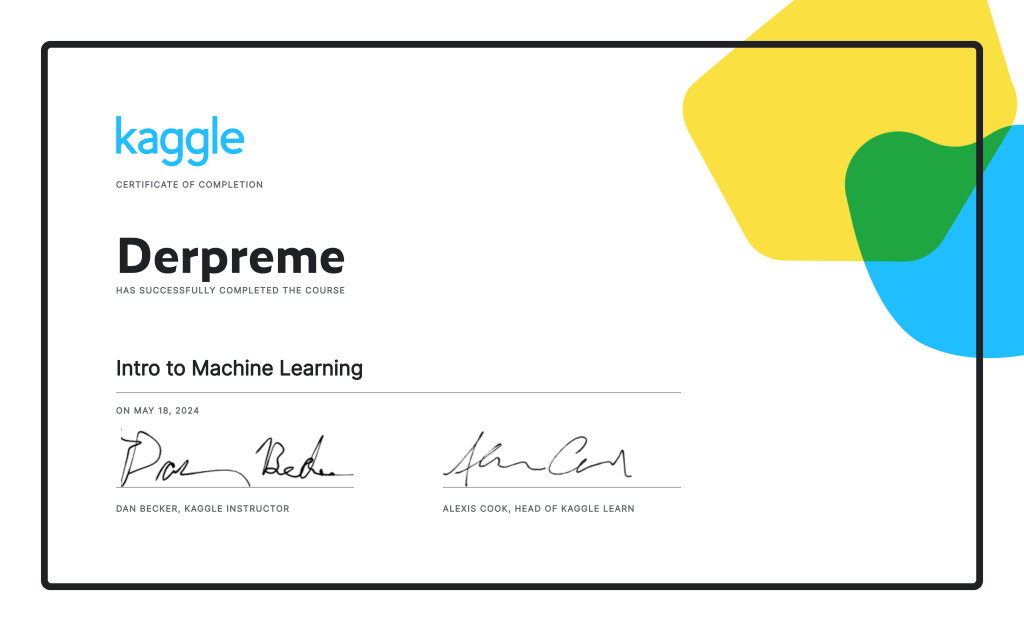
Platform: Kaggle
Completion Date: May 2024
Description: In this course, you learn about the basics of Machine Learning and build basic language models in Python. Teaches simple regression models of decision tree and random forest and explains the concepts behind both models.
My Thoughts: This course provided an easy introduction to the field of machine learning and was the first official course I took to learn these concepts. It is very beginner-friendly, using Kaggle’s own code space and cells that give immediate feedback on whether your code is on track. I highly recommend this course as a beginner’s guide to machine learning and for those interested in trying out Kaggle competitions.
Applied Machine Learning: Algorithms (2019)
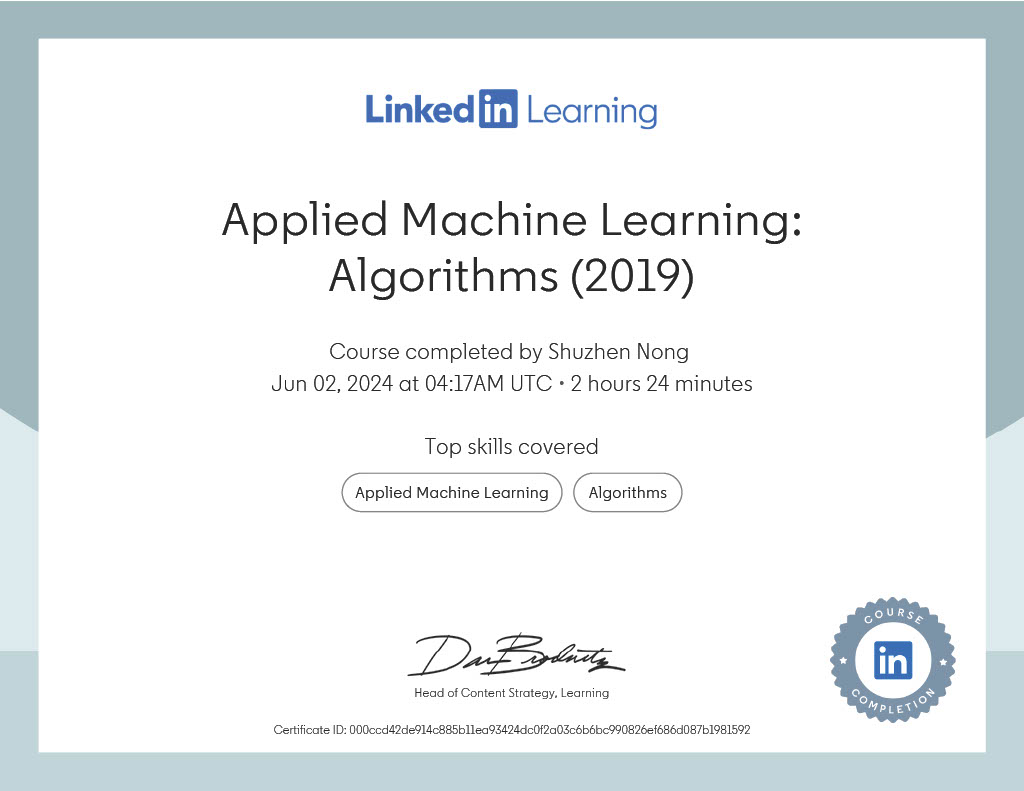
Platform: LinkedIn Learning
Completion Date: June 2024
Description: In this course, instructor Derek Jedamski explores a variety of algorithms, from logistic regression to gradient boosting, and shows how to set a structure that guides you through picking the best one for the problem at hand. Each algorithm has its pros and cons, making each one the preferred choice for certain types of problems. Understanding what actually drives each algorithm, as well as their benefits and drawbacks, can give you a significant competitive advantage as a data scientist.
My Thoughts: This course provides a deeper understanding of machine learning models and their applications, such as the difference between a classification and regression model. It also standardizes the use of Grid Search to tune hyperparameters, which was briefly explored in the foundational course. While this course does not include tests that require you to implement your own code, it excels in teaching how these models work and what they should generally be used for. After finishing the course, I realized how much it gets you accustomed to the process of machine learning model creation and data manipulation. Although it doesn’t get your hands dirty with writing code from scratch, it helps you understand the models well and how you can apply them to practical applications. I believe it is still a great course for not only providing information but also developing basic skills in machine learning.
Deep Learning: Getting Started

Platform: LinkedIn Learning
Completion Date: June 2024
Description: Deep learning as a technology has grown leaps and bounds in the last few years. More and more AI solutions use deep learning as their foundational technology. Studying this technology, however, has several challenges. Most learning resources are math-heavy and are difficult to navigate without good math skills. IT professionals need a simplified resource to learn the concepts and build models quickly. This course aims to provide a simplified path to studying the basics of deep learning and becoming productive quickly. Instructor Kumaran Ponnambalam starts off with an intro to deep learning, including artificial neural networks and architectures. He navigates through various building blocks of neural networks with simple and easy to understand explanations. Kumaran also builds code in Keras to implement these building blocks. He then pulls it all together with an end-to-end exercise. Finally, test what you learned with a deep learning problem and compare your solution with Kumaran’s.
My Thoughts: I truly believe this course excels at its main goal: getting students started with understanding deep learning and neural network concepts. It covers essential topics like vectors, hidden layers, nodes/perceptrons, activation functions, batches, and epochs. While I wish there were more exercises throughout, the final project does an excellent job of testing students’ knowledge and recapping the deep learning process. I would love to see more advanced development of neural network models, but as an introductory course, it’s fantastic. I highly recommend it to anyone looking to dive into deep learning.
Introduction to Large Language Models
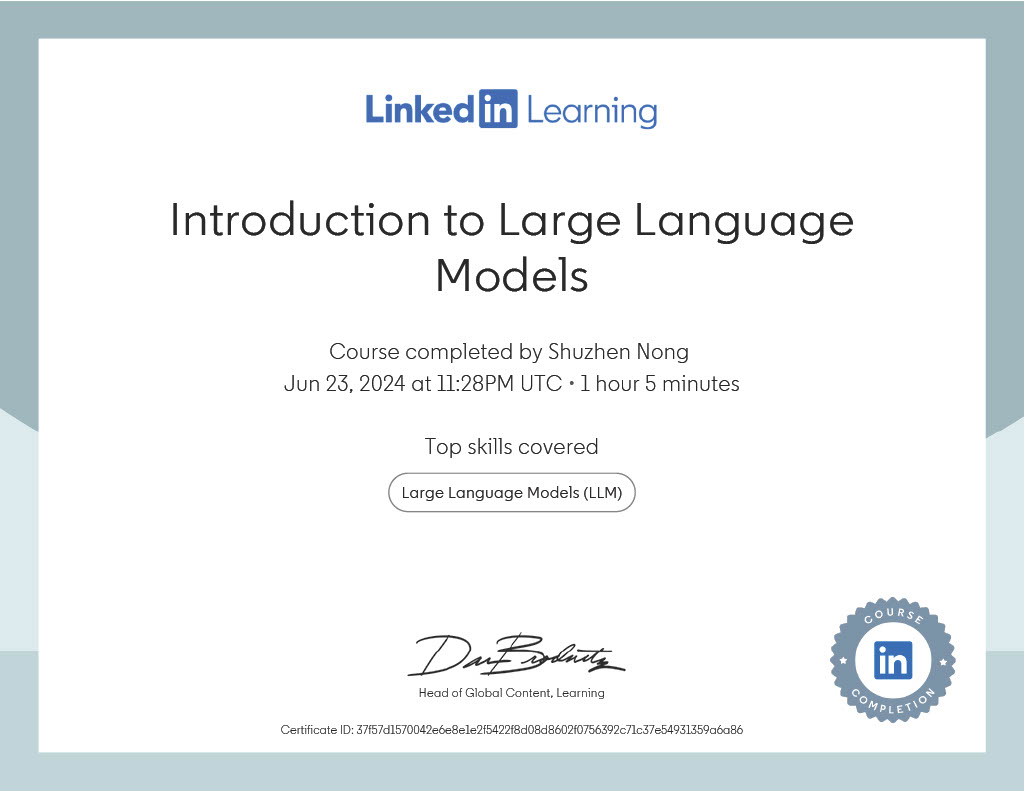
Platform: LinkedIn Learning
Completion Date: June 2024
Description: Large language models (LLMs) have taken the AI world by storm. LLMs are behind some of the biggest AI technologies over the last few years, like ChatGPT and GPT-4. In this course, Jonathan Fernandes provides an overview of LLMs suitable for technical learners and non-technical learners alike. Jonathan shows you what LLMs are and what you can do with them and takes a look under the hood so you can understand why they work the way they do and how they can affect your work. He explains how LLMs are trained and details the components of LLMs, and then takes a look at several different applications of LLMs—including Google’s BERT, GPT-3, PaLM and PaLM 2, ChatGPT and GPT-4, and Llama—and shows you how to compare LLMs using benchmarks.
My Thoughts: My Thoughts: In my opinion, this course is excellent for learning the basics behind the scenes of famous large language models. This course goes through how these models have developed over time and how each model differs from another based-on benchmark tests, resulting in a course that generally covers most questions beginners have about large language models. The course also provides information on how models such as GPT-4 tokenize sentences, how parameters are calculated, and how companies are changing model training based on new discoveries. Websites such as HELM are also explored in this course to allow students to explore models on their own. This is what I like about this course: the fact that it encourages further exploration beyond this introductory course.
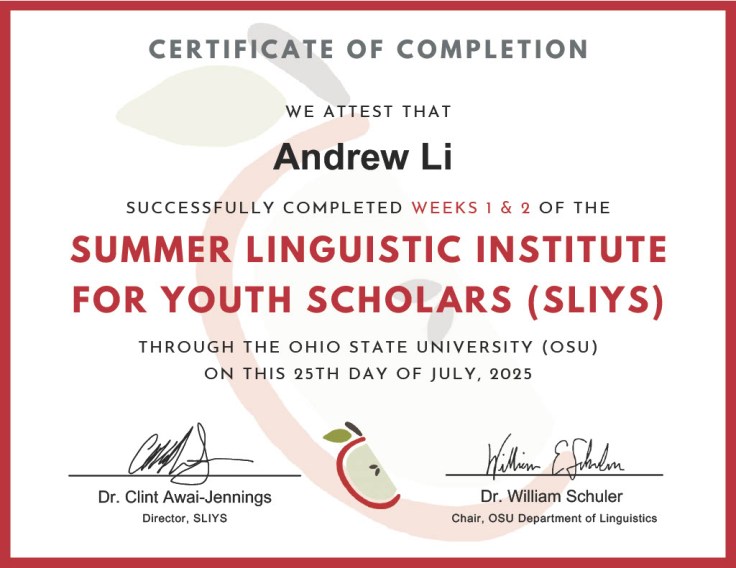
Summer Linguistic Institute for Youth Scholars (SLIYS)
 CompLing Insights