The AI Gap: How Socioeconomic Status Shapes Language Technology Use — A Perspective from Best Social Impact Paper at ACL 2025

The 63rd Annual Meeting of the Association for Computational Linguistics (ACL 2025) recently finished in Vienna, Austria from July 27 to August 1. The conference announced a few awards, one of which is Best Social Impact Paper. This award was given to two papers:

  1. AfriMed-QA: A Pan-African, Multi-Specialty, Medical Question-Answering Benchmark Dataset (by Charles Nimo et al.)
  2. The AI Gap: How Socioeconomic Status Affects Language Technology Interactions (by Elisa Bassignana, Amanda Cercas Curry, and Dirk Hovy).

In this blog post, I’ll talk about the second paper and share the findings from the paper and my thoughts on the topic. You can read the full paper here: https://aclanthology.org/2025.acl-long.914.pdf

What the Paper is About

This paper investigates how socioeconomic status (SES) influences interactions with language technologies, particularly large language models (LLMs) like ChatGPT, highlighting an emerging “AI Gap” that could exacerbate social inequalities. Drawing from the Technology Acceptance Model and prior work on digital divides, the authors argue that SES shapes technology adoption through factors like access, digital literacy, and linguistic habits, potentially biasing LLMs toward higher-SES patterns and underrepresenting lower-SES users.

Methods

The study surveys 1,000 English-speaking participants from the UK and US via Prolific, stratified by self-reported SES using the MacArthur scale (binned as low: 1-3, middle: 4-7, upper: 8-10). It collects sociodemographic data, usage patterns of language technologies (e.g., spell checkers, AI chatbots), and 6,482 real prompts from prior LLM interactions. Analysis includes statistical tests (e.g., chi-square for usage differences), linguistic metrics (e.g., prompt length, concreteness via Brysbaert et al.’s word ratings), topic modeling (using embeddings, UMAP, HDBSCAN, and GPT-4 for cluster descriptions), and markers of anthropomorphism (e.g., phatic expressions like “hi” and politeness markers like “thank you”).

Key Findings

  • Usage Patterns: Higher-SES individuals access more devices daily (e.g., laptops, smartwatches) and use LLMs more frequently (e.g., daily vs. rarely for lower SES). They employ LLMs for work/education (e.g., coding, data analysis, writing) and technical contexts, while lower-SES users favor entertainment, brainstorming, and general knowledge queries. Statistically significant differences exist in frequency (p < 0.001), contexts (p < 0.001), and tasks (p < 0.001).
  • Linguistic Differences in Prompts: Higher-SES prompts are shorter (avg. 18.4 words vs. 27.0 for low SES; p < 0.05) and more abstract (concreteness score: 2.57 vs. 2.66; p < 0.05). Lower-SES prompts show higher anthropomorphism (e.g., more phatic expressions) and concrete language. A bag-of-words classifier distinguishes SES groups (Macro-F1 39.25 vs. baseline 25.02).
  • Topics and Framing: Common topics (e.g., translation, mental health, medical advice, writing, text editing, finance, job, food) appear across groups, but framing varies—e.g., lower SES seeks debt reduction or low-skill jobs; higher SES focuses on investments, travel itineraries, or inclusivity. About 45% of prompts resemble search-engine queries, suggesting LLMs are replacing traditional searches.
  • User Perceptions: Trends indicate lower-SES users anthropomorphize more (e.g., metaphorical verbs like “ask”), while higher-SES use jargon (e.g., “generate”), though not statistically significant.

Discussion and Implications

The findings underscore how SES stratifies LLM use, with higher-SES benefiting more in professional/educational contexts, potentially widening inequalities as LLMs optimize for their patterns. Benchmarks may overlook lower-SES styles, leading to biases. The authors advocate the development of inclusive NLP technologies to accommodate different SES needs and habitus and mitigate the existing AI Gap.

Limitations and Ethics

Limited to Prolific crowdworkers (skewed middle/low SES, tech-savvy), subjective SES measures, and potential LLM-generated responses. Ethical compliance includes GDPR anonymity, opt-outs, and fair compensation (£9/hour).

Overall, the paper reveals SES-driven disparities in technology interactions, urging NLP development to address linguistic and habitual differences for equitable access and reduced digital divides.

My Takeaway

As a high school student who spends a lot of time thinking about fairness in AI, I find this paper important because it reminds us that bias is not just about language or culture, it can also be tied to socioeconomic status. This is something I had not thought much about before. If AI systems are trained mostly on data from higher SES groups, they might misunderstand or underperform for people from lower SES backgrounds. That could affect how well people can use AI for education, job searching, or even just getting accurate information online.

For me, the takeaway is that AI researchers need to test their models with SES diversity in mind, just like they do with gender or language diversity. And as someone interested in computational linguistics, it is inspiring to see that work like this is getting recognized with awards at ACL.

— Andrew

Reflections on Andrew Ng’s Tip: Building Small AI Projects and Its Implications for Computational Linguistics Research

Recently, I read the latest greeting from Andrew Ng in The Batch (Issue #308), where he shared a tip about getting more practice building with AI. His advice really resonated with me, especially as someone exploring computational linguistics research while balancing schoolwork and robotics competitions.


Andrew Ng’s Key Advice

In his post, Andrew Ng emphasized:

If you find yourself with only limited time to build, reduce the scope of your project until you can build something in whatever time you do have.

He shared how he often cuts down an idea into the smallest possible component he can build in an hour or two, rather than waiting for a free weekend or months to tackle the entire project. He illustrated this with his example of creating an audience simulator for practicing public speaking. Instead of building a complex multi-person AI-powered simulation, he started by creating a simple 2D avatar with limited animations that could be expanded later.


Implications for Computational Linguistics Research

Reading this made me think about how I often approach my own computational linguistics projects. Here are a few reflections:

1. Start Small with Linguistic Tasks

In computational linguistics, tasks can feel overwhelming. For example, creating a full sentiment analysis pipeline for multiple languages, building a neural machine translation system, or training large language models are all massive goals.

Andrew Ng’s advice reminds me that it’s okay — and often smarter — to start with a small, well-defined subtask:

  • Instead of building a multilingual parser, start by training a simple POS tagger on a small dataset.
  • Instead of designing a robust speech recognition system, start by building a phoneme classifier for a single speaker dataset.
  • Instead of developing an entire chatbot pipeline, start by implementing a rule-based intent recognizer for a specific question type.

2. Build Prototypes to Test Feasibility

His example of building a minimal audience simulator prototype to get feedback also applies to NLP. For instance, if I want to work on dialect detection on Twitch chat data (something I’ve thought about), I could first build a prototype classifier distinguishing only two dialects or language varieties. Even if it uses basic logistic regression with TF-IDF features, it tests feasibility and lets me get feedback from mentors or peers before expanding.


3. Overcome Perfection Paralysis

As a student, I sometimes hold back on starting a project because I feel I don’t have time to make it perfect. Andrew Ng’s advice to reduce the project scope until you can build something right away is a mindset shift. Even a basic script that tokenizes Twitch messages or parses sentence structures is progress.


4. Practicing Broad Skills by Hacking Small Projects

He also mentioned that building many small projects helps practice a wide range of skills. In computational linguistics, that could mean:

  • Practicing different Python NLP libraries (NLTK, spaCy, Hugging Face)
  • Trying out rule-based vs. machine learning vs. deep learning approaches
  • Exploring new datasets and annotation schemes

Final Thoughts

I really appreciate Andrew Ng’s practical mindset for builders. His advice feels especially relevant to computational linguistics, where small wins accumulate into larger research contributions. Instead of feeling blocked by the scale of a project, I want to keep practicing the art of scoping down and just building something small but meaningful.

If you’re also working on computational linguistics or NLP projects as a student, I hope this inspires you to pick a tiny subtask today and start building.

Let me know if you want me to share a future post listing some small NLP project ideas that I’m working on this summer.

— Andrew

Speeding Up AI for Everyone: The PaPaformer Model Making Language Tech Work on Phones and Low-Power Devices

AI has become more capable than ever, but many of the most advanced tools still require massive cloud servers to run. That means if you want ChatGPT-level performance, you usually need a reliable internet connection and a lot of computing power behind the scenes. But what if you could have that kind of AI right on your phone, even without Wi‑Fi?

That’s where the PaPaformer model comes in.

What is the PaPaformer Model?
PaPaformer is a new AI architecture developed to train large language models more efficiently and make them small enough to run smoothly on low-power devices like smartphones, tablets, or even embedded systems. You can read more about it in the original paper here: PaPaformer: Language Model from Pre-trained Parallel Paths.

Unlike most large models today that require powerful cloud servers to process requests, PaPaformer is designed so the model can be stored and run directly on your device. This means you can use advanced language technology without a constant internet connection. It also helps protect privacy, since your data stays local instead of being sent to the cloud for processing.

Why It Matters
By making AI lighter and more portable, PaPaformer could bring powerful language tools to more people around the world, including those with limited internet access or older devices. It could also make AI faster to respond, since it does not have to constantly send data back and forth to the cloud.

Examples in Action
Imagine using ChatGPT-style features on a budget smartphone in a remote area. With most current apps, like the regular ChatGPT app, you still need a strong internet connection because the AI runs on servers, not your device. But with a PaPaformer-powered tool, the AI would actually run locally, meaning you could:

  • Translate between languages instantly, even without Wi‑Fi
  • Use a speech-to-text tool for endangered languages that works entirely on your device
  • Let teachers translate lessons in real time for students in rural schools without relying on an internet connection
  • Help students write essays in multiple languages privately, without sending drafts to a remote server

This offline capability is the big difference. It is not just accessing AI through the cloud, it is carrying the AI with you wherever you go.

Looking Ahead
If PaPaformer and similar approaches keep improving, we could see a future where advanced AI is available to anyone, anywhere, without needing expensive devices or constant internet access. For someone like me, interested in computational linguistics, this could also open up new possibilities for preserving languages, creating translation tools, and making language technology more inclusive worldwide.

— Andrew

Is the Increasing Trend of Leveraging LLMs like ChatGPT in Writing Research Papers Concerning?

On August 4, 2025, Science published a tech news piece titled “One-fifth of computer science papers may include AI content,” written by Phie Jacobs, a general assignment reporter at Science. The article reports on a large-scale analysis conducted by researchers at Stanford University and the University of California, Santa Barbara. They examined over 1 million abstracts and introductions and found that by September 2024, 22.5% of computer science papers showed signs of input from large language models such as ChatGPT. The researchers used statistical modeling to detect common word patterns linked to AI-generated writing.

This caught my attention because I was surprised at how common AI-generated content has already become in academic research. I agree with the concern raised in the article, particularly this point:

Although the new study primarily looked at abstracts and introductions, Dmitry Kobak (University of Tübingen data scientist) worries authors will increasingly rely on AI to write sections of scientific papers that reference related works. That could eventually cause these sections to become more similar to one another and create a “vicious cycle” in the future, in which new LLMs are trained on content generated by other LLMs.

From my own experience writing research papers over the past few years, I can see why this concern is valid. If you have followed my blog, you know I have published two research papers and am currently working on a third. While working on my papers, I occasionally used ChatGPT (including its Deep Research) to help find peer-reviewed sources for citations instead of relying solely on search engines like Google Scholar. However, I quickly realized that depending on ChatGPT for this task can be risky. In my case, about 30% of the citations it provided were inaccurate, which meant I had to verify each one manually. For reliable academic sourcing, I found Google Scholar much more trustworthy because current LLMs are still prone to “hallucinations.” You may have encountered other AI tools like Consensus AI, a search engine tailored for scientific research and limited to peer-reviewed academic papers only. Compared to ChatGPT Deep Research, it’s faster and more reliable for academic queries, but I strongly recommend always verifying AI outputs, as both tools can occasionally produce inaccuracies.

The Science article also highlights that AI usage varies significantly across disciplines. “The amount of artificial intelligence (AI)-modified sentences in scientific papers had surged by September 2024, almost two years after the release of ChatGPT, according to an analysis.” The table below shows estimates of AI usage by field, with certain disciplines adopting AI much faster than others. James Zou, a computational biologist at Stanford University, suggests these differences may reflect varying levels of familiarity with AI technology.

While the study from Stanford and UCSB is quite solid, Data Scientist Kobak pointed out that the estimates above could be underreported. One reason for this is that some authors may have started removing “red flag” words from manuscripts to avoid detection. For example, the word “delve” became more common right after ChatGPT launched, but its usage dropped sharply once it became widely recognized as a hallmark of AI-generated text.

If you want to read the full article, you can find it here: Science – One-fifth of computer science papers may include AI content.

— Andrew

Update: Here is another more recent report from Nature.

Humanoid Robot Forum 2025: Where Industrial Innovation Takes Center Stage

If you’re as interested in the future of robotics as I am, here’s an event you’ll want to keep an eye on. The Humanoid Robot Forum 2025 is happening on September 23, 2025, in Seattle (my city), Washington. Organized by the Association for Advancing Automation (A3), this one-day event brings together experts from the robotics and AI industries to explore how humanoid robots are being developed and deployed in real-world settings.

What makes this event exciting to me is that it focuses not just on hardware, but also on how technologies like AI and simulation are shaping the next generation of human-like robots. One of the keynotes I’m especially looking forward to is from Amit Goel, Head of Robotics Ecosystem at NVIDIA. His talk, “Advancing Humanoid Robotics Through Generative AI and Simulation,” will dive into how generative AI can help design, train, and test robot behaviors in simulated environments before deploying them in the real world. As someone who’s been exploring AI and NLP through my own projects, this intersection of AI and robotics is something I’m eager to learn more about.

The full agenda includes sessions and speakers from:

  • Diligent
  • Apptronik
  • Agility Robotics
  • PSYONIC
  • GXO
  • Association for Advancing Automation (A3)
  • Boston Dynamics
  • UCSD Advanced Robotics and Controls Lab
  • WiBotic
  • Cobot
  • NVIDIA
  • Cambridge Consultants
  • Toyota Research Institute
  • Sanctuary AI
  • True Ventures

Topics will include scaling up robotic hardware, AI-driven perception and control, power management, investment trends, and more. For anyone curious about how humanoid robots might start appearing in warehouses, hospitals, or even homes, this forum gives a front-row seat to what’s happening in the field.

Even though I won’t be attending in person (I’ve got school, college apps, and robotics season keeping me busy), I’ll definitely be keeping an eye out for takeaways and speaker highlights.

You can check out the full agenda and register for the event here:
👉 Humanoid Robot Forum 2025

— Andrew

How NLP Helps Robots Handle Interruptions: A Summary of JHU Research

I recently came across an awesome study from Johns Hopkins University describing how computational linguistics and NLP can make robots better conversational partners by teaching them how to handle interruptions, a feature that feels basic for humans but is surprisingly hard for machines.


What the Study Found

Researchers trained a social robot powered by a large language model (LLM) to manage real-time interruptions based on speaker intent. They categorized interruptions into four types: Agreement, Assistance, Clarification, and Disruption.

By analyzing human conversations from interviews to informal discussions, they designed strategies tailored to each interruption type. For example:

  • If someone agrees or helps, the robot pauses, nods, and resumes speaking.
  • When someone asks for clarification, the robot explains and continues.
  • For disruptive interruptions, the robot can either hold the floor to summarize its remaining points before yielding to the human user, or it can stop talking immediately.

How NLP Powers This System

The robot uses an LLM to:

  1. Detect overlapping speech
  2. Classify the interrupter’s intent
  3. Select the appropriate response strategy

In tests involving tasks and conversations, the system correctly interpreted interruptions about 89% of the time and responded appropriately 93.7% of the time.


Why This Matters in NLP and Computational Linguistics

This work highlights how computational linguistics and NLP are essential to human-robot interaction.

  • NLP does more than generate responses; it helps robots understand nuance, context, and intent.
  • Developing systems like this requires understanding pause cues, intonation, and conversational flow, all core to computational linguistics.
  • It shows how multimodal AI, combining language with behavior, can enable more natural and effective interactions.

What I Found Most Interesting

The researchers noted that users didn’t like when the robot “held the floor” too long during disruptive interruptions. It reminded me how pragmatic context matters. Just like people expect some rules in human conversations, robots need these conversational skills too.


Looking Ahead

This research expands what NLP can do in real-world settings like healthcare, education, and social assistants. For someone like me who loves robots and language, it shows how computational linguistics helps build smarter, more human-friendly AI systems.

If you want to dive deeper, check out the full report from Johns Hopkins:
Talking robots learn to manage human interruptions

— Andrew

How Computational Linguistics Is Powering the Future of Robotics?

As someone who’s been involved in competitive robotics through VEX for several years and recently started diving into computational linguistics, I’ve been wondering: how do these two fields connect?

At first, it didn’t seem obvious. VEX Robotics competitions (like the one my team Ex Machina participated in at Worlds 2025) are mostly about designing, building, and coding autonomous and driver-controlled robots to complete physical tasks. There’s no direct language processing involved… at least not yet. But the more I’ve learned, the more I’ve realized that computational linguistics plays a huge role in making real-world robots smarter, more useful, and more human-friendly.

Here’s what I’ve learned about how these two fields intersect and where robotics is heading.


1. Human-Robot Communication

The most obvious role of computational linguistics in robotics is helping robots understand and respond to human language. This is powered by natural language processing (NLP), a core area of computational linguistics. Think about assistants like Alexa or social robots like Pepper. They rely on language models and parsing techniques to interpret what we say and give meaningful responses.

This goes beyond voice control. It’s about making robots that can hold conversations, answer questions, or even ask for clarification when something is unclear. For robots to work effectively with people, they need language skills, not just motors and sensors.


2. Task Execution and Instruction Following

Another fascinating area is how robots can convert human instructions into actual actions. For example, if someone says, “Pick up the red cup from the table,” a robot must break that down: What object? What location? What action?

This is where semantic parsing comes in—turning language into structured data the robot can use to plan its moves. In VEX, we manually code our autonomous routines, but imagine if a future version of our robot could listen to instructions in plain English and adapt its behavior in real time.


3. Understanding Context and Holding a Conversation

Human communication is complex. We often leave things unsaid, refer to past ideas, or use vague phrases like “that one over there.” Research in discourse modeling and context tracking helps robots manage this complexity.

This is especially useful in collaborative environments. Think hospital robots assisting nurses, or factory robots working alongside people. They need to understand not just commands but also user intent, tone, and changing context.


4. Multimodal Understanding

Robots don’t just rely on language. They also use vision, sensors, and spatial awareness. A good example is interpreting a command like, “Hand me the tool next to the blue box.” The robot has to match those words with what it sees.

This is called multimodal integration, where the robot combines language and visual information. In my own robotics experience, we’ve used vision sensors to detect field elements, but future robots will need to combine that visual input with spoken instructions to act intelligently in dynamic spaces.


5. Emotional and Social Intelligence

This part really surprised me. Sentiment analysis and affective computing are helping robots detect emotions in voice or text, which makes them more socially aware.

This could be important for assistive robots that help the elderly, teach kids, or support people with disabilities. It’s not just about understanding words. It’s about understanding people.


6. Learning from Language

Computational linguistics also helps robots learn and adapt over time. Instead of hardcoding every behavior, researchers are working on ways for robots to learn from manuals, online resources, or natural language feedback.

This is especially exciting as large language models continue to evolve. Imagine a robot reading its own instruction manual or watching a video tutorial and figuring out how to do a new task.


Looking Ahead

While none of this technology is part of the current VEX Robotics competition (at least not yet), understanding how computational linguistics connects to robotics gives me a whole new appreciation for where robotics is going. It also makes me excited about studying this intersection more deeply in college.

Whether it’s through smarter voice assistants, more helpful home robots, or AI systems that respond naturally, computational linguistics is quietly shaping the next generation of robotics.

— Andrew

How to Cold Email Professors for Research Opportunities as a High School Student: My Experience and Advice

One question I hear a lot from high school students (including from myself when I first started) is: How can I find a research opportunity if I don’t already have connections in academia? Many of us don’t have family or school networks tied to university research, so it can feel impossible to break in. But one effective way is through cold emailing professors.

In this post, I’d like to share my personal experiences and practical advice on how to approach cold emailing, especially if you’re a high school student aiming to start your research journey.


1. Identify Professors in Your Research Area

Start by thinking about what you’re genuinely interested in researching. For me, it was computational linguistics and NLP. Then, search faculty pages on university department websites to find professors working in that field. Look at their personal websites or lab pages to understand their recent projects and publications.

Here’s what I learned:
Even if a professor’s website only mentions research positions for undergraduates or graduate students, it doesn’t necessarily mean they’re closed off to high school students. In many cases, if you are academically ready and motivated, they may be open to mentoring you as well.


2. Craft a Polite and Targeted Introduction Email

Your email should briefly:

  • Introduce yourself (name, grade, school)
  • Share your specific research interests
  • Explain why you are reaching out to them in particular, referencing their recent work
  • Mention any relevant projects you’ve done

When I reached out, I shared my school transcript, certificates (such as those from LinkedIn courses or my University of Washington summer class), and most importantly, my previous research projects and sample work. Demonstrating both preparation and passion makes a difference.

In my emails, I often referenced my nonprofit organization, Student Echo, and my research on analyzing survey data using LLMs. Show that you care about their work and that you want to learn under their guidance while contributing meaningfully to their projects.


3. Clarify Your Intentions and Expectations

Make it clear in your email that:

  • You are volunteering your time to assist with research
  • You do not expect compensation or an official title
  • You are simply seeking experience, mentorship, and an opportunity to contribute

Professors are often busy and have limited budgets. By clarifying that you’re offering help without adding financial or administrative burden, you make it easier for them to say yes.


4. Be Patient and Follow Up Politely

Professors receive many emails and have packed schedules. Wait at least two weeks before sending a follow-up email. In my case, some professors responded quickly with a clear “no” but were kind enough to refer me to colleagues. If they don’t, you can politely ask if they know anyone in their department who might accept high school students for research.

If you don’t hear back, don’t be discouraged. I cold emailed five professors at top-tier universities. Four didn’t work out, but one professor replied and became my first research mentor. That one response can change everything.


5. Prepare for Your First Meeting

Once a professor shows interest:

  • Set up a meeting (virtual or in-person, depending on location)
  • Before the meeting, email them your resume, sample research work, and a personal statement outlining your goals and why you’re interested in their lab

During the meeting:

  • Be humble, respectful, and grateful for their time
  • Show confidence and passion about your research interests
  • If they ask technical questions you don’t know, be honest and express your willingness to learn

In my case, after my virtual meeting, the professor invited me to attend his weekly lab meetings with his graduate students. Eventually, he assigned me to collaborate with one of his Ph.D. students. It was such an amazing opportunity, and I’m so grateful for his trust and mentorship.


Final Thoughts

Cold emailing professors can feel intimidating, but remember: every professor was once a student who started somewhere too. If you’re passionate, prepared, and polite, your efforts will eventually pay off. Even one “yes” can open the door to your first professional research experience.

I hope this post helps you take your first step toward finding a research opportunity. Feel free to let me know if you want me to share a sample cold email template in a future post.

Good luck, and keep pushing your curiosity forward!

— Andrew

What I Learned (and Loved) at SLIYS: Two Weeks of Linguistic Discovery at Ohio State

This summer, I had the chance to participate in both SLIYS 1 and SLIYS 2—the Summer Linguistic Institute for Youth Scholars—hosted by the Ohio State University Department of Linguistics. Across two weeks packed with lectures, workshops, and collaborative data collection, I explored the structure of language at every level: from the individual sounds we make to the complex systems that govern meaning and conversation. But if I had to pick just one highlight, it would be the elicitation sessions—hands-on explorations with real language data that made the abstract suddenly tangible.

SLIYS 1: Finding Language in Structure

SLIYS 1 started with the fundamentals—consonants, vowels, and the International Phonetic Alphabet (IPA)—but quickly expanded into diverse linguistic territory: morphology, syntax, semantics, and pragmatics. Each day featured structured lectures covering topics like sociolinguistic variation, morphological structures, and historical linguistics. Workshops offered additional insights, from analyzing sentence meanings to exploring language evolution.

The core experience, however, was our daily elicitation sessions. My group tackled Serbo-Croatian, collaboratively acting as elicitors and transcribers to construct a detailed grammar sketch. We identified consonant inventories, syllable structures (like CV, CVC, and CCV patterns), morphological markers for plural nouns and verb tenses, and syntactic word orders. Through interactions with our language consultant, we tested hypotheses directly, discovering intricacies like how questions were formed using particles like dahlee, and how adjective-noun order worked. This daily practice gave theory immediate clarity and meaning, shaping our skills as linguists-in-training.

SLIYS 2: Choosing My Path in Linguistics

SLIYS 2 built upon our initial foundations, diving deeper into phonological analysis, morphosyntactic properties, and the relationship between language and cognition. This week offered more autonomy, allowing us to select workshops tailored to our interests. My choices included sessions on speech perception, dialectology, semiotics, and linguistic anthropology—each challenging me to think more broadly about language as both cognitive and cultural phenomena.

Yet again, the elicitation project anchored our experience, this time exploring Georgian. Our group analyzed Georgian’s distinctive pluralization system, polypersonal verb agreement (verbs agreeing with both subjects and objects), and flexible sentence orders (SVO/SOV). One fascinating detail we uncovered was how nouns remained singular when preceded by numbers. Preparing our final presentation felt especially rewarding, bringing together the week’s linguistic discoveries in a cohesive narrative. Presenting to our peers crystallized not just what we learned, but how thoroughly we’d internalized it.

More Than Just a Summer Program

What I appreciated most about SLIYS was how seriously it treated us as student linguists. The instructors didn’t just lecture—they listened, challenged us, and encouraged our curiosity. Whether we were learning about deixis or discourse analysis, the focus was always on asking better questions, not just memorizing answers.

By the end of SLIYS 2, I found myself thinking not only about how language works, but why we study it in the first place. Language is a mirror to thought, a map of culture, and a bridge between people—and programs like SLIYS remind me that it’s also something we can investigate, question, and build understanding from.

Moments from SLIYS 2: A Snapshot of a Summer to Remember

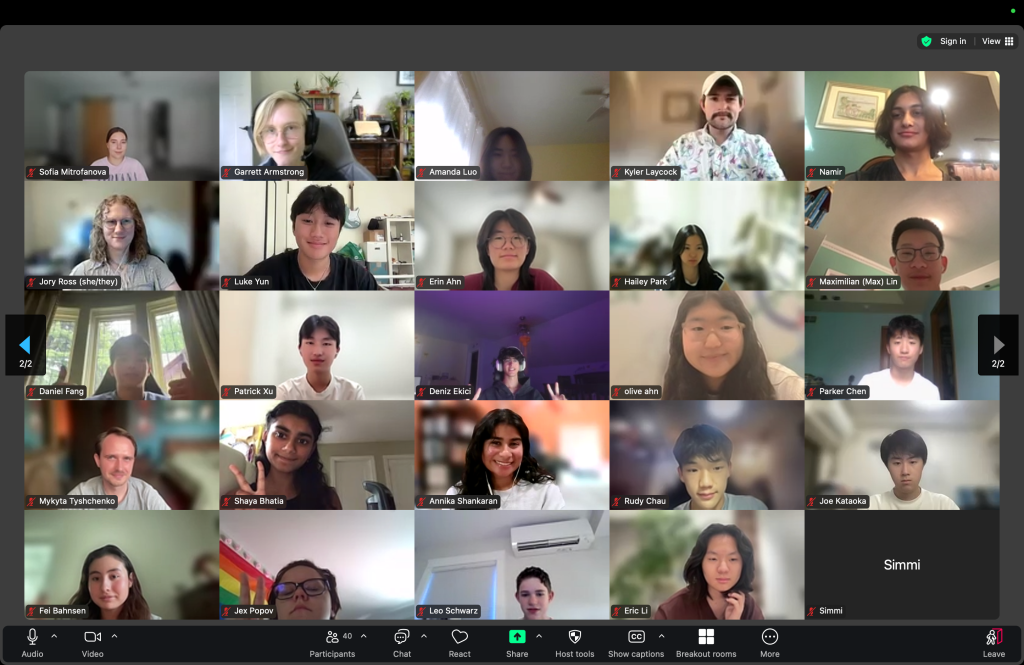
As SLIYS 2 came to a close, our instructors captured these Zoom screenshots to help us remember the community, curiosity, and collaboration that made this experience so meaningful.

Special Thanks to the SLIYS 2025 Team

This incredible experience wouldn’t have been possible without the passion, insight, and dedication of the SLIYS 2025 instructors. Each one brought something unique to the table—whether it was helping us break down complex syntax, introducing us to sociolinguistics through speech perception, or guiding us through our elicitation sessions with patience and curiosity. I’m especially grateful for the way they encouraged us to ask deeper questions and think like real linguists.

Special thanks to:

  • Kyler Laycock – For leading with energy, making phonetics and dialectology come alive, and always reminding us how much identity lives in the details of speech.
  • Jory Ross – For guiding us through speech perception and conversational structure, and for sharing her excitement about how humans really process language.
  • Emily Sagasser – For her insights on semantics, pragmatics, and focus structure, and for pushing us to think about how language connects to social justice and cognition.
  • Elena Vaikšnoraitė – For their thoughtful instruction in syntax and psycholinguistics, and for showing us the power of connecting data across languages.
  • Dr. Clint Awai-Jennings – For directing the program with care and purpose—and for showing us that it’s never too late to turn a passion for language into a life’s work.

Thank you all for making SLIYS 1 and 2 an unforgettable part of my summer.

— Andrew

WAIC 2025: What Geoffrey Hinton’s “Tiger” Warning Taught Me About AI’s Future

At the end of July (7/26 – 7/28), Shanghai hosted the 2025 World Artificial Intelligence Conference (WAIC), drawing over 1,200 participants from more than 40 countries. Even though I wasn’t there, I followed the conference closely, especially the keynote from Geoffrey Hinton, the so-called “Godfather of AI.” His message? AI is advancing faster than we expect, and we need global cooperation to make sure it stays aligned with human values.

Hinton’s talk was historic. It was his first public appearance in China, and he even stood throughout his address despite back pain, which was noted by local media. One quote really stuck with me: “Humans have grown accustomed to being the most intelligent species in the world – what if that’s no longer the case?” That’s a big question, and as someone who’s diving deeper into computational linguistics and large language models, I felt both amazed and a little uneasy.

His warning compared superintelligent AI to a tiger we’re raising as a pet. If we’re not careful, he said, “the tiger” might one day turn on us. The point wasn’t to scare everyone, but to highlight why we can’t rely on simply pulling the plug if AI systems surpass human intelligence. Hinton believes we need to train AI to be good from the beginning because shutting it down later might not be an option.

WAIC 2025 wasn’t all doom and gloom though. Hinton also talked about the huge potential of AI to accelerate science. For example, he highlighted DeepMind’s AlphaFold as a breakthrough that solved a major biology challenge, predicting protein structures. That shows how powerful AI can be when guided properly.

What stood out the most was the recurring theme of cooperation. Hinton and others, like former Google CEO Eric Schmidt, emphasized the need for global partnerships on AI safety and ethics. Hinton even signed the “Shanghai AI Safety Consensus” with other experts to support international collaboration. The message was clear: no single country can or should handle AI’s future alone.

As a high school student passionate about AI and language, I’m still learning how these pieces fit together. But events like WAIC remind me that the future of AI isn’t just about building smarter systems, it’s also about making sure they work for everyone.

For those interested, here’s a more detailed summary of Hinton’s latest speech: Pandaily Report on WAIC 2025

You can also explore the official WAIC website here: https://www.worldaic.com.cn/

— Andrew

Blog at WordPress.com.

Up ↑