In my recent blog post, I discussed Citation Hallucinations at NeurIPS and What They Teach Us. As a student researcher, I think many people are asking the same question: can we use AI tools that help us get citations right without made-up references?
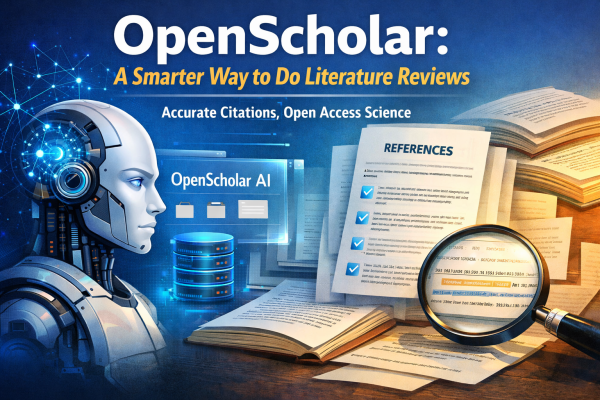
I recently read a Nature article that gave a strong answer. The article introduces OpenScholar, a retrieval-augmented system that combines a language model with a database of about 45 million open-access papers. Instead of relying only on model memory, OpenScholar retrieves papers first and then generates responses with explicit citation links.
Why this matters
For research workflows, citation reliability is everything. When references are wrong, the writing process breaks down quickly. OpenScholar is designed to reduce that risk by grounding claims in retrieved literature before generating the final response.
According to the article, OpenScholar is also:
- Open source
- Relatively lightweight
- Deployable locally
- Built for scientific search and literature review
That combination is important because it supports both accuracy and reproducibility, which are essential in research settings.
Reported performance
Nature reports that in the OpenScholar evaluations, the 8B model outperformed GPT-4o on correctness in their benchmark and significantly reduced fabricated citations. The article also notes that citation behavior was described as being comparable to human experts in their testing context.
Comparison with OpenAI deep research tools
The article places OpenScholar in a broader trend. Since OpenScholar was first posted on arXiv about 14 months ago, companies such as OpenAI have integrated similar retrieval-based “deep research” methods into commercial LLM products, improving factual accuracy and citation quality compared with earlier model behavior.
OpenScholar’s main distinction in that landscape is cost-efficiency plus openness. Nature cites the OpenScholar team saying it can run at a fraction of the cost of GPT-5 with deep research, while still grounding outputs in a large scientific corpus.
Limitations to keep in mind
The article is clear that OpenScholar is not perfect. The authors acknowledge two major limitations:
- It does not always retrieve the most representative or most relevant papers for every query.
- It is limited by the scope of its indexed database.
So even though OpenScholar helps with citation hallucinations, retrieval quality remains a core bottleneck. In practice, researchers still need to verify paper relevance and coverage before relying on output.
Final thoughts
My takeaway is that this is a meaningful step forward for student researchers and independent scholars. Better grounding, lower cost, and open access can make high-quality literature review tools more available to more people.
Nature also quotes an outside researcher who argues that if OpenScholar remains free, it could become one of the most widely used tools for scientific search. I think that is very possible.
If you have tested OpenScholar, share what worked and what did not. I may feature reader feedback in a follow-up post.
— Andrew
4,919 hits
 CompLing Insights