Real-Time Language Translation: A High Schooler’s Perspective on AI’s Role in Breaking Down Global Communication Barriers

As a high school senior fascinated by computational linguistics, I am constantly amazed by how artificial intelligence (AI) is transforming the way we communicate across languages. One of the most exciting trends in this field is real-time language translation, technology that lets people talk, text, or even video chat across language barriers almost instantly. Whether it is through apps like Google Translate, AI-powered earbuds like AirPods Pro 3, or live captions in virtual meetings, these tools are making the world feel smaller and more connected. For someone like me, who dreams of studying computational linguistics in college, this topic is not just cool. It is a glimpse into how AI can bring people together.

What is Real-Time Language Translation?

Real-time language translation uses AI, specifically natural language processing (NLP), to convert speech or text from one language to another on the fly. Imagine wearing earbuds that translate a Spanish conversation into English as you listen, or joining a Zoom call where captions appear in your native language as someone speaks Mandarin. These systems rely on advanced models that combine Automatic Speech Recognition (ASR), machine translation, and text-to-speech synthesis to deliver seamless translations.

As a student, I see these tools in action all the time. For myself, I use a translation app to chat with my grandparents in China. These technologies are not perfect yet, but they are improving fast, and I think they are a great example of how computational linguistics can make a real-world impact.

Why This Matters to Me

Growing up in a diverse community, I have seen how language barriers can make it hard for people to connect. My neighbor, whose family recently immigrated, sometimes finds it hard to make himself understood at the store or during school meetings. Tools like real-time translation could help him feel more included. Plus, as someone who loves learning languages (I am working on Spanish, Chinese, and a bit of Japanese), I find it exciting to think about technology that lets us communicate without needing to master every language first.

This topic also ties into my interest in computational linguistics. I want to understand how AI can process the nuances of human language, like slang, accents, or cultural references, and make communication smoother. Real-time translation is a perfect challenge for this field because it is not just about words; it is about capturing meaning, tone, and context in a split second.

How Real-Time Translation Works

From what I have learned, real-time translation systems have a few key steps:

  1. Speech Recognition: The AI listens to spoken words and converts them into text. This is tricky because it has to handle background noise, different accents, or even mumbled speech. For example, if I say “Hey, can you grab me a soda?” in a noisy cafeteria, the AI needs to filter out the chatter.
  2. Machine Translation: The text is translated into the target language. Modern systems use neural machine translation models, which are trained on massive datasets to understand grammar, idioms, and context. For instance, translating “It’s raining cats and dogs” into French needs to convey the idea of heavy rain, not literal animals.
  3. Text-to-Speech or Display: The translated text is either spoken aloud by the AI or shown as captions. This step has to be fast and natural so the conversation flows.

These steps happen in milliseconds, which is mind-blowing when you think about how complex language is. I have been experimenting with Python libraries like Hugging Face’s Transformers to play around with basic translation models, and even my simple scripts take seconds to process short sentences!

Challenges in Real-Time Translation

While the technology is impressive, it’s not without flaws. Here are some challenges I’ve noticed through my reading and experience:

  • Slang and Cultural Nuances: If I say “That’s lit” to mean something is awesome, an AI might translate it literally, confusing someone in another language. Capturing informal phrases or cultural references is still tough.
  • Accents and Dialects: People speak differently even within the same language. A translation system might struggle with a heavy Southern drawl or a regional dialect like Puerto Rican Spanish.
  • Low-Resource Languages: Many languages, especially Indigenous or less-spoken ones, do not have enough data to train robust models. This means real-time translation often works best for global languages like English or Chinese.
  • Context and Ambiguity: Words can have multiple meanings. For example, “bank” could mean a riverbank or a financial institution. AI needs to guess the right one based on the conversation.

These challenges excite me because they are problems I could help solve someday. For instance, I am curious about training models with more diverse datasets or designing systems that ask for clarification when they detect ambiguity.

Real-World Examples

Real-time translation is already changing lives. Here are a few examples that inspire me:

  • Travel and Tourism: Apps like Google Translate’s camera feature let you point at a menu in Japanese and see English translations instantly. This makes traveling less stressful for people like my parents, who love exploring but do not speak the local language.
  • Education: Schools with international students use tools like Microsoft Translator to provide live captions during classes. This helps everyone follow along, no matter their native language.
  • Accessibility: Real-time captioning helps deaf or hard-of-hearing people participate in multilingual conversations, like at global conferences or online events.

I recently saw a YouTube demo of AirPods Pro 3 that translates speech in real time. They are not perfect, but the idea of wearing a device that lets you talk to anyone in the world feels like something out of a sci-fi movie.

What is Next for Real-Time Translation?

As I look ahead, I think real-time translation will keep getting better. Researchers are working on:

  • Multimodal Systems: Combining audio, text, and even visual cues (like gestures) to improve accuracy. Imagine an AI that watches your body language to understand sarcasm!
  • Low-Resource Solutions: Techniques like transfer learning could help build models for languages with limited data, making translation more inclusive.
  • Personalized AI: Systems that learn your speaking style or favorite phrases to make translations sound more like you.

For me, the dream is a world where language barriers do not hold anyone back. Whether it is helping a new immigrant talk to his/her doctor, letting students collaborate across countries, or making travel more accessible, real-time translation could be a game-changer.

My Takeaway as a Student

As a high schooler, I am just starting to explore computational linguistics, but real-time translation feels like a field where I could make a difference. I have been messing around with Python and NLP libraries, and even small projects, like building a script to translate short phrases, get me excited about the possibilities. I hope to take courses in college that dive deeper into neural networks and language models so I can contribute to tools that connect people.

If you are a student like me, I encourage you to check out free resources like Hugging Face tutorials or Google’s AI blog to learn more about NLP. You do not need to be an expert to start experimenting. Even a simple translation project can teach you a ton about how AI understands language.

Final Thoughts

Real-time language translation is more than just a cool tech trick. It is a way to build bridges between people. As someone who loves languages and technology, I am inspired by how computational linguistics is making this possible. Sure, there are challenges, but they are also opportunities for students like us to jump in and innovate. Who knows? Maybe one day, I will help build an AI that lets anyone talk to anyone, anywhere, without missing a beat.

What do you think about real-time translation? Have you used any translation apps or devices? Share your thoughts in the comments on my blog at https://andrewcompling.blog/2025/10/16/real-time-language-translation-a-high-schoolers-perspective-on-ais-role-in-breaking-down-global-communication-barriers/!

— Andrew

4,811 hits

Rethinking AI Bias: Insights from Professor Resnik’s Position Paper

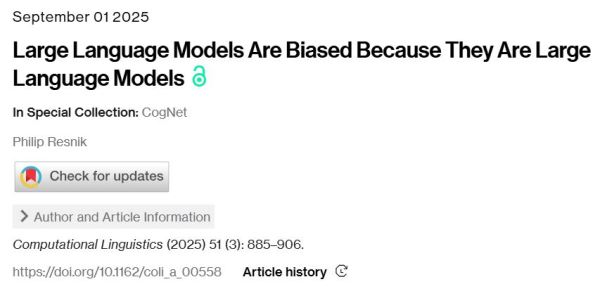
I recently read Professor Philip Resnik’s thought-provoking position paper, “Large Language Models Are Biased Because They Are Large Language Models,” published in Computational Linguistics 51(3), which is available via open access. This paper challenges conventional perspectives on bias in artificial intelligence, prompting a deeper examination of the inherent relationship between bias and the foundational design of large language models (LLMs). Resnik’s primary objective is to stimulate critical discussion by arguing that harmful biases are an inevitable outcome of the current architecture of LLMs. The paper posits that addressing these biases effectively requires a fundamental reevaluation of the assumptions underlying the design of AI systems driven by LLMs.

What the paper argues

  • Bias is built into the very goal of an LLM. A language model tries to predict the next word by matching the probability patterns of human text. Those patterns come from people. People carry stereotypes, norms, and historical imbalances. If an LLM learns the patterns faithfully, it learns the bad with the good. The result is not a bug that appears once in a while. It is a direct outcome of the objective the model optimizes.
  • Models cannot tell “what a word means” apart from “what is common” or “what is acceptable.” Resnik uses a nurse example. Some facts are definitional (A nurse is a kind of healthcare worker). Other facts are contingent but harmless (A nurse is likely to wear blue clothing at work). Some patterns are contingent and harmful if used for inference (A nurse is likely to wear a dress to a formal occasion). Current LLMs do not have an internal line that separates meaning from contingent statistics or that flags the normative status of an inference. They just learn distributions.
  • Reinforcement Learning from Human Feedback (RLHF) and other mitigations help on the surface, but they have limits. RLHF tries to steer a pre-trained model toward safer outputs. The process relies on human judgments that vary by culture and time. It also has to keep the model close to its pretraining, or the model loses general ability. That tradeoff means harmful associations can move underground rather than disappear. Some studies even find covert bias remains after mitigation (Gallegos et al. 2024; Hofmann et al. 2024). To illustrate this, consider an analogy: The balloon gets squeezed in one place, then bulges in another.
  • The root cause is a hard-core, distribution-only view of language. When meaning is treated as “whatever co-occurs with what,” the model has no principled way to encode norms. The paper suggests rethinking foundations. One direction is to separate stable, conventional meaning (like word sense and category membership) from contextual or conveyed meaning (which is where many biases live). Another idea is to modularize competence, so that using language in socially appropriate ways is not forced to emerge only from next-token prediction. None of this is easy, but it targets the cause rather than only tuning symptoms.

Why this matters

Resnik is not saying we should give up. He is saying that quick fixes will not fully erase harm when the objective rewards learning whatever is frequent in human text. If we want models that reason with norms, we need objectives and representations that include norms, not only distributions.

Conclusion

This paper offers a clear message. Bias is not only a content problem in the data. It is also a design problem in how we define success for our models. If the goal is to build systems that are both capable and fair, then the next steps should focus on objectives, representations, and evaluation methods that make room for norms and constraints. That is harder than prompt tweaks, but it is the kind of challenge that can move the field forward.

Link to the paper: Large Language Models Are Biased Because They Are Large Language Models

— Andrew

4,811 hits

Can AI Save Endangered Languages?

Recently, I’ve been thinking a lot about how computational linguistics and AI intersect with real-world issues, beyond just building better chatbots or translation apps. One question that keeps coming up for me is: Can AI actually help save endangered languages?

As someone who loves learning languages and thinking about how they shape culture and identity, I find this topic both inspiring and urgent.


The Crisis of Language Extinction

Right now, linguists estimate that out of the 7,000+ languages spoken worldwide, nearly half are at risk of extinction within this century. This isn’t just about losing words. When a language disappears, so does a community’s unique way of seeing the world, its oral traditions, its science, and its cultural knowledge.

For example, many Indigenous languages encode ecological wisdom, medicinal knowledge, and cultural philosophies that aren’t easily translated into global languages like English or Mandarin.


How Can Computational Linguistics Help?

Here are a few ways I’ve learned that AI and computational linguistics are being used to preserve and revitalize endangered languages:

1. Building Digital Archives

One of the first steps in saving a language is documenting it. AI models can:

  • Transcribe and archive spoken recordings automatically, which used to take linguists years to do manually
  • Align audio with text to create learning materials
  • Help create dictionaries and grammatical databases that preserve the language’s structure for future generations

Projects like ELAR (Endangered Languages Archive) work on this in partnership with local communities.


2. Developing Machine Translation Tools

Although data scarcity makes it hard to build translation systems for endangered languages, researchers are working on:

  • Transfer learning, where AI models trained on high-resource languages are adapted to low-resource ones
  • Multilingual language models, which can translate between many languages and improve with even small datasets
  • Community-centered translation apps, which let speakers record, share, and learn their language interactively

For example, Google’s AI team and university researchers are exploring translation models for Indigenous languages like Quechua, which has millions of speakers but limited online resources.


3. Revitalization Through Language Learning Apps

Some communities are partnering with tech developers to create mobile apps for language learning tailored to their heritage language. AI can help:

  • Personalize vocabulary learning
  • Generate example sentences
  • Provide speech recognition feedback for pronunciation practice

Apps like Duolingo’s Hawaiian and Navajo courses are small steps in this direction. Ideally, more tools would be built directly with native speakers to ensure accuracy and cultural respect.


Challenges That Remain

While all this sounds promising, there are real challenges:

  • Data scarcity. Many endangered languages have very limited recorded data, making it hard to train accurate models
  • Ethical concerns. Who owns the data? Are communities involved in how their language is digitized and shared?
  • Technical hurdles. Language structures vary widely, and many NLP models are still biased towards Indo-European languages

Why This Matters to Me

As a high school student exploring computational linguistics, I’m passionate about language diversity. Languages aren’t just tools for communication. They are stories, worldviews, and cultural treasures.

Seeing AI and computational linguistics used to preserve rather than replace human language reminds me that technology is most powerful when it supports people and cultures, not just when it automates tasks.

I hope to work on projects like this someday, using NLP to build tools that empower communities to keep their languages alive for future generations.


Final Thoughts

So, can AI save endangered languages? Maybe not alone. But combined with community efforts, linguists, and ethical frameworks, AI can be a powerful ally in documenting, preserving, and revitalizing the world’s linguistic heritage.

If you’re interested in learning more, check out projects like ELAR (Endangered Languages Archive) or the Living Tongues Institute. Let me know if you want me to write another post diving into how multilingual language models actually work.

— Andrew

What I Learned (and Loved) at SLIYS: Two Weeks of Linguistic Discovery at Ohio State

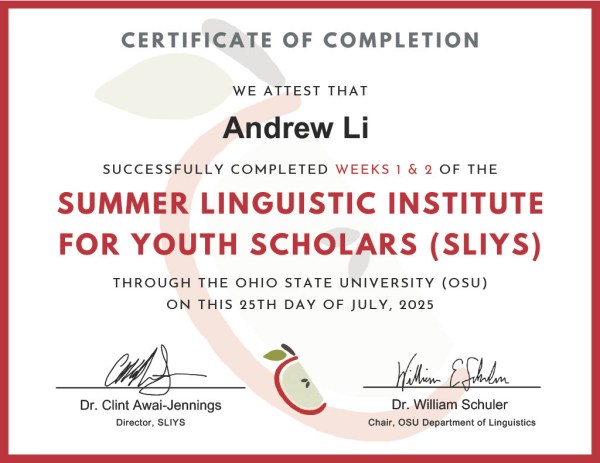
This summer, I had the chance to participate in both SLIYS 1 and SLIYS 2—the Summer Linguistic Institute for Youth Scholars—hosted by the Ohio State University Department of Linguistics. Across two weeks packed with lectures, workshops, and collaborative data collection, I explored the structure of language at every level: from the individual sounds we make to the complex systems that govern meaning and conversation. But if I had to pick just one highlight, it would be the elicitation sessions—hands-on explorations with real language data that made the abstract suddenly tangible.

SLIYS 1: Finding Language in Structure

SLIYS 1 started with the fundamentals—consonants, vowels, and the International Phonetic Alphabet (IPA)—but quickly expanded into diverse linguistic territory: morphology, syntax, semantics, and pragmatics. Each day featured structured lectures covering topics like sociolinguistic variation, morphological structures, and historical linguistics. Workshops offered additional insights, from analyzing sentence meanings to exploring language evolution.

The core experience, however, was our daily elicitation sessions. My group tackled Serbo-Croatian, collaboratively acting as elicitors and transcribers to construct a detailed grammar sketch. We identified consonant inventories, syllable structures (like CV, CVC, and CCV patterns), morphological markers for plural nouns and verb tenses, and syntactic word orders. Through interactions with our language consultant, we tested hypotheses directly, discovering intricacies like how questions were formed using particles like dahlee, and how adjective-noun order worked. This daily practice gave theory immediate clarity and meaning, shaping our skills as linguists-in-training.

SLIYS 2: Choosing My Path in Linguistics

SLIYS 2 built upon our initial foundations, diving deeper into phonological analysis, morphosyntactic properties, and the relationship between language and cognition. This week offered more autonomy, allowing us to select workshops tailored to our interests. My choices included sessions on speech perception, dialectology, semiotics, and linguistic anthropology—each challenging me to think more broadly about language as both cognitive and cultural phenomena.

Yet again, the elicitation project anchored our experience, this time exploring Georgian. Our group analyzed Georgian’s distinctive pluralization system, polypersonal verb agreement (verbs agreeing with both subjects and objects), and flexible sentence orders (SVO/SOV). One fascinating detail we uncovered was how nouns remained singular when preceded by numbers. Preparing our final presentation felt especially rewarding, bringing together the week’s linguistic discoveries in a cohesive narrative. Presenting to our peers crystallized not just what we learned, but how thoroughly we’d internalized it.

More Than Just a Summer Program

What I appreciated most about SLIYS was how seriously it treated us as student linguists. The instructors didn’t just lecture—they listened, challenged us, and encouraged our curiosity. Whether we were learning about deixis or discourse analysis, the focus was always on asking better questions, not just memorizing answers.

By the end of SLIYS 2, I found myself thinking not only about how language works, but why we study it in the first place. Language is a mirror to thought, a map of culture, and a bridge between people—and programs like SLIYS remind me that it’s also something we can investigate, question, and build understanding from.

Moments from SLIYS 2: A Snapshot of a Summer to Remember

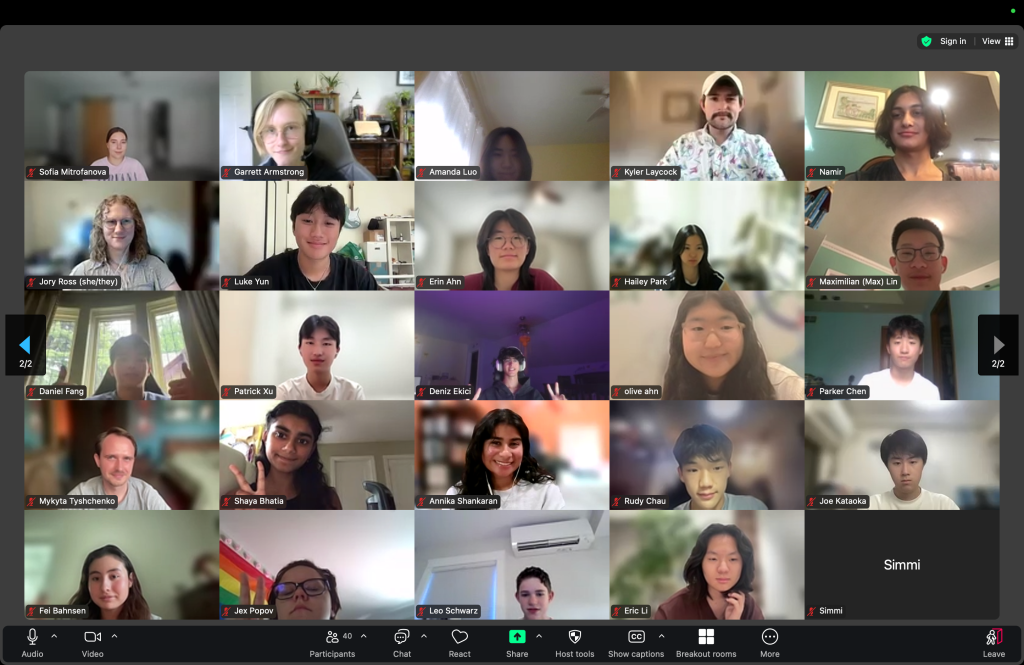
As SLIYS 2 came to a close, our instructors captured these Zoom screenshots to help us remember the community, curiosity, and collaboration that made this experience so meaningful.

Special Thanks to the SLIYS 2025 Team

This incredible experience wouldn’t have been possible without the passion, insight, and dedication of the SLIYS 2025 instructors. Each one brought something unique to the table—whether it was helping us break down complex syntax, introducing us to sociolinguistics through speech perception, or guiding us through our elicitation sessions with patience and curiosity. I’m especially grateful for the way they encouraged us to ask deeper questions and think like real linguists.

Special thanks to:

  • Kyler Laycock – For leading with energy, making phonetics and dialectology come alive, and always reminding us how much identity lives in the details of speech.
  • Jory Ross – For guiding us through speech perception and conversational structure, and for sharing her excitement about how humans really process language.
  • Emily Sagasser – For her insights on semantics, pragmatics, and focus structure, and for pushing us to think about how language connects to social justice and cognition.
  • Elena Vaikšnoraitė – For their thoughtful instruction in syntax and psycholinguistics, and for showing us the power of connecting data across languages.
  • Dr. Clint Awai-Jennings – For directing the program with care and purpose—and for showing us that it’s never too late to turn a passion for language into a life’s work.

Thank you all for making SLIYS 1 and 2 an unforgettable part of my summer.

— Andrew

WAIC 2025: What Geoffrey Hinton’s “Tiger” Warning Taught Me About AI’s Future

At the end of July (7/26 – 7/28), Shanghai hosted the 2025 World Artificial Intelligence Conference (WAIC), drawing over 1,200 participants from more than 40 countries. Even though I wasn’t there, I followed the conference closely, especially the keynote from Geoffrey Hinton, the so-called “Godfather of AI.” His message? AI is advancing faster than we expect, and we need global cooperation to make sure it stays aligned with human values.

Hinton’s talk was historic. It was his first public appearance in China, and he even stood throughout his address despite back pain, which was noted by local media. One quote really stuck with me: “Humans have grown accustomed to being the most intelligent species in the world – what if that’s no longer the case?” That’s a big question, and as someone who’s diving deeper into computational linguistics and large language models, I felt both amazed and a little uneasy.

His warning compared superintelligent AI to a tiger we’re raising as a pet. If we’re not careful, he said, “the tiger” might one day turn on us. The point wasn’t to scare everyone, but to highlight why we can’t rely on simply pulling the plug if AI systems surpass human intelligence. Hinton believes we need to train AI to be good from the beginning because shutting it down later might not be an option.

WAIC 2025 wasn’t all doom and gloom though. Hinton also talked about the huge potential of AI to accelerate science. For example, he highlighted DeepMind’s AlphaFold as a breakthrough that solved a major biology challenge, predicting protein structures. That shows how powerful AI can be when guided properly.

What stood out the most was the recurring theme of cooperation. Hinton and others, like former Google CEO Eric Schmidt, emphasized the need for global partnerships on AI safety and ethics. Hinton even signed the “Shanghai AI Safety Consensus” with other experts to support international collaboration. The message was clear: no single country can or should handle AI’s future alone.

As a high school student passionate about AI and language, I’m still learning how these pieces fit together. But events like WAIC remind me that the future of AI isn’t just about building smarter systems, it’s also about making sure they work for everyone.

For those interested, here’s a more detailed summary of Hinton’s latest speech: Pandaily Report on WAIC 2025

You can also explore the official WAIC website here: https://www.worldaic.com.cn/

— Andrew

I-Language vs. E-Language: What Do They Mean in Computational Linguistics?

In the summer of 2025, I started working on a computational linguistics research project using Twitch data under the guidance of Dr. Sidney Wong, a Computational Sociolinguist. As someone who is still pretty new to this field, I was mainly focused on learning how to conduct literature reviews, help narrow down research topics, clean data, build models, and extract insights.

One day, Dr. Wong suggested I look into the concept of I-language vs. E-language from theoretical linguistics. At first, I wasn’t sure why this mattered. I thought, Isn’t language just… language?

But as I read more, I realized that understanding this distinction changes how we think about language data and what we’re actually modeling when we work with NLP.

In this post, I want to share what I’ve learned about I-language and E-language, and why this distinction is important for computational linguistics research.


What Is I-Language?

I-language stands for “internal language.” This idea was proposed by Noam Chomsky, who argued that language is fundamentally a mental system. I-language refers to the internal, cognitive grammar that allows us to generate and understand sentences. It is about:

  • The unconscious rules and structures stored in our minds
  • Our innate capacity for language
  • The mental system that explains why we can produce and interpret sentences we’ve never heard before

For example, if I say, “The cat sat on the mat,” I-language is the system in my brain that knows the sentence is grammatically correct and what it means, even though I may never have said that exact sentence before.

I-language focuses on competence (what we know about our language) rather than performance (how we actually use it in real life).


What Is E-Language?

E-language stands for “external language.” This is the language we actually hear and see in the world, such as:

  • Conversations between Twitch streamers and their viewers
  • Tweets, Reddit posts, books, and articles
  • Any linguistic data that exists outside the mind

E-language is about observable language use. It includes everything from polished academic writing to messy chat messages filled with abbreviations, typos, and slang.

Instead of asking, “What knowledge do speakers have about their language?”, E-language focuses on, “What do speakers actually produce in practice?”


Why Does This Matter for Computational Linguistics?

When it comes to computational linguistics and NLP, this distinction affects:

1. What We Model

  • I-language-focused research tries to model the underlying grammatical rules and mental representations. For example, building a parser that captures syntax structures based on linguistic theory.
  • E-language-focused research uses real-world data to build models that predict or generate language based on patterns, regardless of theoretical grammar. For example, training a neural network on millions of Twitch comments to generate chat responses.

2. Research Goals

If your goal is to understand how humans process and represent language cognitively, you’re leaning towards I-language research. This includes computational psycholinguistics, cognitive modeling, and formal grammar induction.

If your goal is to build practical NLP systems for tasks like translation, summarization, or sentiment analysis, you’re focusing on E-language. These projects care about performance and usefulness, even if the model doesn’t match linguistic theory.


3. How Models Are Evaluated

I-language models are evaluated based on how well they align with linguistic theory or native speaker intuitions about grammaticality.

E-language models are evaluated using performance metrics, such as accuracy, BLEU scores, or perplexity, based on how well they handle real-world data.


My Thoughts as a Beginner

When Dr. Wong first told me about this distinction, I thought it was purely theoretical. But now, while working with Twitch data, I see the importance of both views.

For example:

  • If I want to study how syntax structures vary in Twitch chats, I need to think in terms of I-language to analyze grammar.
  • If I want to build an NLP model that generates Twitch-style messages, I need to focus on E-language to capture real-world usage patterns.

Neither approach is better than the other. They just answer different types of questions. I-language is about why language works the way it does, while E-language is about how language is actually used in the world.


Final Thoughts

Understanding I-language vs. E-language helps me remember that language isn’t just data for machine learning models. It’s a human system with deep cognitive and social layers. Computational linguistics becomes much more meaningful when we consider both perspectives: What does the data tell us? and What does it reveal about how humans think and communicate?

If you’re also just starting out in this field, I hope this post helps you see why these theoretical concepts matter for practical NLP and AI work. Let me know if you want a follow-up post about other foundational linguistics ideas for computational research.

— Andrew

SCiL vs. ACL: What’s the Difference? (A Beginner’s Take from a High School Student)

As a high school student just starting to explore computational linguistics, I remember being confused by two organizations: SCiL (Society for Computation in Linguistics) and ACL (Association for Computational Linguistics). They both focus on language and computers, so at first, I assumed they were basically the same thing.

It wasn’t until recently that I realized they are actually two different academic communities. Each has its own focus, audience, and style of research. I’ve had the chance to engage with both, which helped me understand how they are connected and how they differ.

Earlier this year, I had the opportunity to co-author a paper that was accepted to a NAACL 2025 workshop (May 3–4). NAACL stands for the North American Chapter of the Association for Computational Linguistics. It is a regional chapter that serves researchers in the United States, Canada, and Mexico. NAACL follows ACL’s mission and guidelines but focuses on more local events and contributions.

This summer, I will be participating in SCiL 2025 (July 18–19), where I hope to meet researchers and learn more about how computational models are used to study language structure and cognition. Getting involved with both events helped me better understand what makes SCiL and ACL unique, so I wanted to share what I’ve learned for other students who might also be starting out.

SCiL and ACL: Same Field, Different Focus

Both SCiL and ACL are academic communities interested in studying human language using computational methods. However, they focus on different kinds of questions and attract different types of researchers.

Here’s how I would explain the difference.

SCiL (Society for Computation in Linguistics)

SCiL is more focused on using computational tools to support linguistic theory and cognitive science. Researchers here are often interested in how language works at a deeper level, including areas like syntax, semantics, and phonology.

The community is smaller and includes people from different disciplines like linguistics, psychology, and cognitive science. You are likely to see topics such as:

  • Computational models of language processing
  • Formal grammars and linguistic structure
  • Psycholinguistics and cognitive modeling
  • Theoretical syntax and semantics

If you are interested in how humans produce and understand language, and how computers can help us model that process, SCiL might be a great place to start.

ACL (Association for Computational Linguistics)

ACL has a broader and more applied focus. It is known for its work in natural language processing (NLP), artificial intelligence, and machine learning. The research tends to focus on building tools and systems that can actually use human language in practical ways.

The community is much larger and includes researchers from both academia and major tech companies like Google, OpenAI, Meta, and Microsoft. You will see topics such as:

  • Language models like GPT, BERT, and LLaMA
  • Machine translation and text summarization
  • Speech recognition and sentiment analysis
  • NLP benchmarks and evaluation methods

If you want to build or study real-world AI systems that use language, ACL is the place where a lot of that cutting-edge research is happening.

Which One Should You Explore First?

It really depends on what excites you most.

If you are curious about how language works in the brain or how to use computational tools to test theories of language, SCiL is a great choice. It is more theory-driven and focused on cognitive and linguistic insights.

If you are more interested in building AI systems, analyzing large datasets, or applying machine learning to text and speech, then ACL might be a better fit. It is more application-oriented and connected to the latest developments in NLP.

They both fall under the larger field of computational linguistics, but they come at it from different angles. SCiL is more linguistics-first, while ACL is more NLP-first.

Final Thoughts

I am still early in my journey, but understanding the difference between SCiL and ACL has already helped me navigate the field better. Each community asks different questions, uses different methods, and solves different problems, but both are helping to push the boundaries of how we understand and work with language.

I am looking forward to attending SCiL 2025 this summer, and I will definitely write about that experience afterward. In the meantime, I hope this post helps other students who are just starting out and wondering where to begin.

— Andrew

Happy New Year 2025! Reflecting on a Year of Growth and Looking Ahead

As we welcome 2025, I want to take a moment to reflect on the past year and share some exciting plans for the future.

Highlights from 2024

  • Academic Pursuits: I delved deeper into Natural Language Processing (NLP), discovering Jonathan Dunn’s Natural Language Processing for Corpus Linguistics, which seamlessly integrates computational methods with traditional linguistic analysis.
  • AI and Creativity: Exploring the intersection of AI and human creativity, I read Garry Kasparov’s Deep Thinking, which delves into his experiences with AI in chess and offers insights into the evolving relationship between humans and technology.
  • Competitions and Courses: I actively participated in Kaggle competitions, enhancing my machine learning and data processing skills, which are crucial in the neural network and AI aspects of Computational Linguistics.
  • Community Engagement: I had the opportunity to compete in the 2024 VEX Robotics World Championship and reintroduced our school’s chess club to the competitive scene, marking our return since pre-COVID times.

Looking Forward to 2025

  • Expanding Knowledge: I plan to continue exploring advanced topics in NLP and AI, sharing insights and resources that I find valuable.
  • Engaging Content: Expect more in-depth discussions, tutorials, and reviews on the latest developments in computational linguistics and related fields.
  • Community Building: I aim to foster a community where enthusiasts can share knowledge, ask questions, and collaborate on projects.

Thank you for being a part of this journey. Your support and engagement inspire me to keep exploring and sharing. Here’s to a year filled with learning, growth, and innovation!

A Book That Expanded My Perspective on NLP: Natural Language Processing for Corpus Linguistics by Jonathan Dunn

Book Link: https://doi.org/10.1017/9781009070447

As I dive deeper into the fascinating world of Natural Language Processing (NLP), I often come across resources that reshape my understanding of the field. One such recent discovery is Jonathan Dunn’s Natural Language Processing for Corpus Linguistics. This book, a part of the Elements in Corpus Linguistics series by Cambridge University Press, stands out for its seamless integration of computational methods with traditional linguistic analysis.

A Quick Overview

The book serves as a guide to applying NLP techniques to corpus linguistics, especially in dealing with large-scale corpora that are beyond the scope of traditional manual analysis. It discusses how models like text classification and text similarity can help address linguistic problems such as categorization (e.g., identifying part-of-speech tags) and comparison (e.g., measuring stylistic similarities between authors).

What I found particularly intriguing is its structure, which is built around five compelling case studies:

  1. Corpus-Based Sociolinguistics: Exploring geographic and social variations in language use.
  2. Corpus Stylistics: Understanding authorship through stylistic differences in texts.
  3. Usage-Based Grammar: Analyzing syntax and semantics via computational models.
  4. Multilingualism Online: Investigating underrepresented languages in digital spaces.
  5. Socioeconomic Indicators: Applying corpus analysis to non-linguistic fields like politics and sentiment in customer reviews.

The book is as much a practical resource as it is theoretical. Accompanied by Python notebooks and a stand-alone Python package, it provides hands-on tools to implement the discussed methods—a feature that makes it especially appealing to readers with a technical bent.

A Personal Connection

My journey with this book is a bit more personal. While exploring NLP, I had the chance to meet Jonathan Dunn, who shared invaluable insights about this field. One of his students, Sidney Wong, recommended this book to me as a starting point for understanding how computational methods can expand corpus linguistics. It has since become a cornerstone of my learning in this area.

What Makes It Unique

Two aspects of Dunn’s book particularly resonated with me:

  1. Ethical Considerations: As corpus sizes grow, so do the ethical dilemmas associated with their use. From privacy issues to biases in computational models, the book doesn’t shy away from discussing the darker side of large-scale text analysis. This balance between innovation and responsibility is a critical takeaway for anyone venturing into NLP.
  2. Interdisciplinary Approach: Whether you’re a linguist looking to incorporate computational methods or a computer scientist aiming to understand linguistic principles, this book bridges the gap between the two disciplines beautifully. It encourages a collaborative perspective, which is essential in fields as expansive as NLP and corpus linguistics.

Who Should Read It?

If you’re a student, researcher, or practitioner with an interest in exploring how NLP can scale linguistic analysis, this book is for you. Its accessibility makes it suitable for beginners, while the advanced discussions and hands-on code offer plenty for seasoned professionals to learn from.

For me, Natural Language Processing for Corpus Linguistics isn’t just a book—it’s a toolkit, a mentor, and an inspiration rolled into one. As I continue my journey in NLP, I find myself revisiting its chapters for insights and ideas.

Blog at WordPress.com.

Up ↑