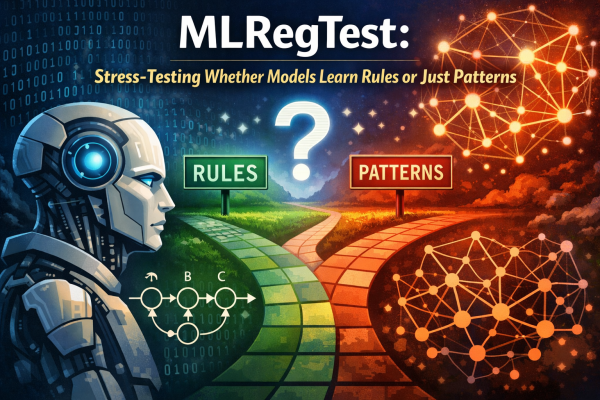
When people say “AI understands language,” they usually mean it can produce fluent text, summarize an article, or answer questions. Those abilities are impressive, but they can also hide a real problem: a model can look correct while relying on shortcuts that break in the exact cases we care about most.
That is why I have been interested in MLRegTest, a benchmark designed to stress-test sequence models using 1,800 carefully constructed regular languages. Instead of judging a model by how human its writing sounds, MLRegTest asks a simpler, sharper question: can a model learn a rule, and then apply it reliably when the test gets harder or more precise?
What is MLRegTest, in plain terms?
MLRegTest is a large collection of tiny, made-up “languages” built from simple symbols. Imagine an alphabet like A, B, C, D, and strings such as “AAB C” or “BBB A.” Each language has a hidden rule that determines whether a string belongs to it. The model learns from labeled examples and then answers a yes or no question: does this string follow the rule?
This might sound far from English or Spanish, but it is actually a powerful way to test something very relevant to computational linguistics: how models represent patterns and dependencies across sequences.
Why regular languages?
Regular languages are a class of formal languages that can be described using tools like regular expressions and finite-state machines. They are simpler than full human language, but they still capture many meaningful pattern constraints. MLRegTest uses regular languages because they let researchers control the task in a way that is difficult with natural text. The rules are fully known, the labels are unambiguous, and researchers can generate unlimited data under controlled conditions. That makes it possible to test specific kinds of generalization rather than only measuring how well a model matches the distribution of a dataset.
What makes MLRegTest different from typical benchmarks?
First, MLRegTest is not just one dataset. It is a suite of datasets drawn from 1,800 distinct regular languages, and those languages are organized by properties such as logical complexity and the kinds of constraints they express. That organization matters because “pattern learning” is not a single ability. Some rules are easy to approximate but hard to learn exactly, and some require models to track information across long spans of a sequence. MLRegTest is designed to probe those differences rather than hiding them inside one average score.
Second, the benchmark is built to examine long-distance dependencies in a controlled way. Sequence models often struggle when the relevant information is far apart in the input, and MLRegTest gives researchers a systematic way to test whether a model can handle that challenge.
Third, MLRegTest includes a kind of evaluation highlighted in Stony Brook’s write-up: border tests. These focus on edge cases where examples come in near-identical pairs. The strings might differ by only one symbol, but one is in the language and the other is not. Those are the cases where the true rule matters most, and they are also where shortcut strategies are most likely to fail. According to the Stony Brook announcement, models tended to struggle more on these boundary cases, even when they looked strong on more typical examples, which suggests that they can learn approximations instead of learning the rule itself.
What did the researchers evaluate?
The JMLR paper evaluates multiple neural architectures, including recurrent models and transformers, and reports that performance varies significantly depending on the kind of test set, the class of language, and the model architecture. That is useful because it pushes back on the idea that “a strong model is strong at everything.” MLRegTest makes it easier to ask where a system is strong and where it breaks, and to tie those results to specific properties of the pattern being learned.
Why this matters for evaluating language models
Even though MLRegTest does not test natural language directly, it targets a core issue in NLP evaluation: benchmarks can be “won” for the wrong reasons. A model can score well by picking up statistical hints that correlate with labels without learning the intended generalization. Border tests and other controlled generalization tests help researchers ask whether a model stays consistent when inputs shift in principled ways, whether it generalizes beyond the training regime, and whether it fails exactly when the rule becomes tight. Those questions matter if we want models that are dependable in real settings, especially when rare edge cases are the dangerous ones.
A quiet challenge to “just feed it more data”
MLRegTest also pushes back on a common assumption in AI right now: if a model struggles, the fix is simply more data. The benchmark is asking what happens if the deeper issue is not data quantity, but what the model is actually learning. This is not only a scientific concern but also a practical one. In high-stakes applications like robotic medical assistance or self-driving cars, the most serious situations are often rare. A particular combination of weather, road design, sensor noise, and unpredictable human behavior might occur only one in a million times. In medicine, a rare complication might be exactly the case where you cannot afford a mistake. The border tests connect directly to this idea because they emphasize edge cases where a tiny change can flip the correct decision, which is where shortcut learning becomes most dangerous.
The takeaway is simple: reliability is not the same thing as average performance. If a system only works well on patterns it has seen thousands of times, it may still be fragile in the exact scenarios we care about most. MLRegTest is valuable because it helps us measure that fragility directly instead of waiting to discover it in the real world.
A high school senior takeaway
As a high school senior interested in computational linguistics research, MLRegTest feels like a strong example of what careful evaluation looks like. It controls the task so we know what the model should learn, varies difficulty in interpretable ways so “harder” actually means something specific, and probes failure modes instead of stopping at one headline number. More broadly, it connects to a theme I keep coming back to in NLP: we do not just want systems that perform well. We want systems whose performance we can explain and trust.
References
- van der Poel, Sam, et al. “MLRegTest: A Benchmark for the Machine Learning of Regular Languages.” Journal of Machine Learning Research, vol. 25, no. 283, 2024, pp. 1–45. https://www.jmlr.org/papers/v25/23-0518.html
- Stony Brook University AI news announcement (February 13, 2026): “How Much Does AI Really Understand: Stress-testing Neural Networks with 1,800 Language Patterns.” https://ai.stonybrook.edu/about-us/News/how-much-does-ai-really-understand-stress-testing-neural-networks-1800-language
— Andrew
5,279 hits









 CompLing Insights