Citation Hallucinations at NeurIPS and What They Teach Us

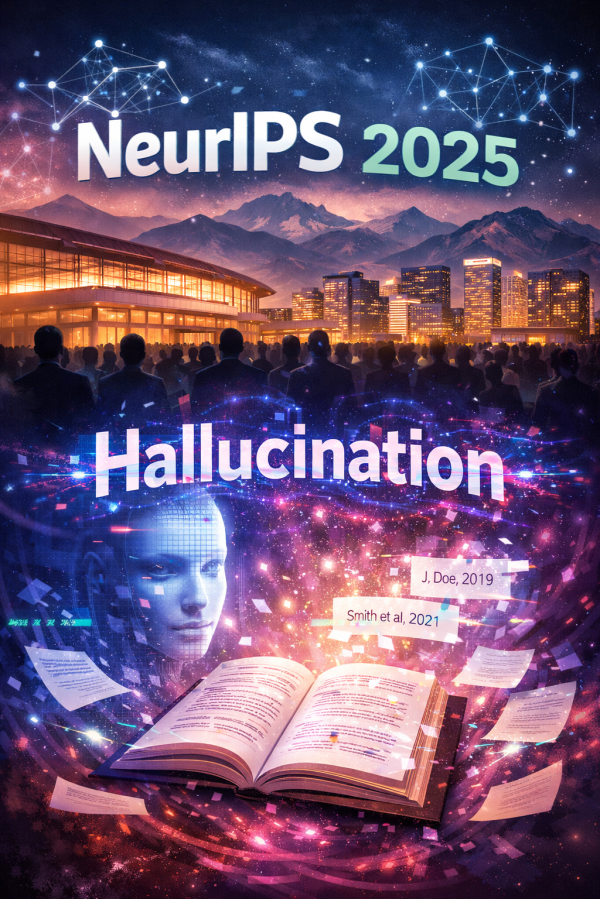
I’m writing this post about a recent discovery by GPTZero, reported by Shmatko et al. 2026. The finding sparked significant discussion across the research community (Goldman 2026). While hallucinations produced by large language models have been widely acknowledged, far less attention has been paid to hallucinations in citations. Even reviewers at top conferences such as NeurIPS failed to catch citation hallucination issues, showing how easily these errors can slip through existing academic safeguards.

For students and early-career researchers, this discovery should serve as a warning. AI tools can meaningfully improve research efficiency, especially during early-stage tasks like brainstorming, summarizing papers, or organizing a literature review. At the same time, these tools introduce new risks when they are treated as sources rather than assistants. Citation accuracy remains the responsibility of the researcher, not the model.

As a junior researcher, I have used AI tools such as ChatGPT to help with literature reviews in my own work. In practice, AI can make the initial stages of research much easier by surfacing themes, suggesting keywords, or summarizing large volumes of text. However, I have also seen how easily this convenience can introduce errors. Citation hallucinations are particularly dangerous because they often look plausible. A reference may appear to have a reasonable title, realistic authors, and a convincing venue, even though it does not actually exist. Unless each citation is verified, these errors can quietly make their way into drafts.

According to GPTZero, citation hallucinations tend to fall into several recurring patterns. One common issue is the combination or paraphrasing of titles, authors, or publication details from one or more real sources. Another is the outright fabrication of authors, titles, URLs, DOIs, or publication venues such as journals or conferences. A third pattern involves modifying real citations by extrapolating first names from initials, adding or dropping authors, or subtly paraphrasing titles in misleading ways. These kinds of errors are easy to overlook during review, particularly when the paper’s technical content appears sound.

The broader lesson here is not that AI tools should be avoided, but that they must be used carefully and responsibly. AI can be valuable for identifying research directions, generating questions, or helping navigate unfamiliar literature. It should not be relied on to generate final citations or to verify the existence of sources. For students in particular, it is important to build habits that prioritize checking references against trusted databases and original papers.

Looking ahead, this finding reinforces an idea that has repeatedly shaped how I approach my own work. Strong research is not defined by speed alone, but by care, verification, and reflection. As AI becomes more deeply embedded in academic workflows, learning how to use it responsibly will matter just as much as learning the technical skills themselves.

References

Shmatko, N., Adam, A., and Esau, P. GPTZero finds 100 new hallucinations in NeurIPS 2025 accepted papers, Jan. 21, 2026

Goldman, S. NeurIPS, one of the world’s top academic AI conferences, accepted research papers with 100+ AI-hallucinated citations, new report claims. Fortune, Jan 21, 2026

— Andrew

4,811 hits

A Short Guide to Understanding NeurIPS 2025 Through Three Key Reports

Introduction

NeurIPS (Neural Information Processing Systems) 2025 brought together the global machine learning community for its thirty ninth annual meeting. It represents both continuity and change in the world’s premier machine learning conference. Held December 2 to 7 in San Diego, with a simultaneous secondary site in Mexico City, the conference drew enormous attention from researchers across academia, industry, and policy. The scale was striking. There were more than 21,575 submissions and over 5,200 accepted papers, which placed the acceptance rate at about 24.5 percent. With such breadth, NeurIPS 2025 offered a detailed look at the current state of AI research and the questions shaping its future.

Why I Follow the Conference

Even though my senior year has been filled with college applications and demanding coursework, I continue to follow NeurIPS closely because it connects directly to my future interests in computational linguistics and NLP. Reading every paper is unrealistic, but understanding the broader themes is still possible. For students or early researchers who want to stay informed without diving into thousands of pages, the following three references are especially helpful.

References:

  1. NeurIPS 2025: A Guide to Key Papers, Trends & Stats (Intuition Labs)
  2. Trends in AI at NeurIPS 2025 (Medium)
  3. At AI’s biggest gathering, its inner workings remain a mystery (NBC News)

Executive Summary of the Three Reports

1. Intuition Labs: Key Papers, Trends, and Statistics

The Intuition Labs summary of NeurIPS 2025 is a detailed, professionally structured report that provides a comprehensive overview of the conference. It opens with an Executive Summary highlighting key statistics, trends, awards, and societal themes, followed by sections on Introduction and Background, NeurIPS 2025 Organization and Scope (covering dates, venues, scale, and comparisons to prior years), and Submission and Review Process (with subsections on statistics, responsible practices, and ethics).

The report then delves into the core content through Technical Program Highlights (key themes, notable papers, and interdisciplinary bridging), Community and Social Aspects (affinity events, workshops, industry involvement, and conference life), Data and Evidence: Trends Analysis, Case Studies and Examples (including the best paper on gated attention and an invited talk panel), Implications and Future Directions, and a concluding section that reflects on the event’s significance. This logical flow, from context and logistics to technical depth, community, evidence, specifics, and forward-looking insights, makes it an ideal reference for understanding the conference’s breadth and maturation of AI research. It is a helpful summary for readers who want both numbers and high level insights.

2. Medium: Trends in AI at NeurIPS 2025

This article highlights key trends observed at NeurIPS 2025 through workshops, signaling AI’s maturation beyond text-based models. Major themes include embodied AI in physical/biological realms (e.g., animal communication via bioacoustics, health applications with regulatory focus, robotic world models, spatial reasoning, brain-body foundations, and urban/infrastructure optimization); reliability and interpretability (robustness against unreliable data, regulatable designs, mechanistic interpretability of model internals, and lifecycle-aware LLM evaluations); advanced reasoning and agents (multi-turn interactions, unified language-agent-world models, continual updates, mathematical/logical reasoning, and scientific discovery); and core theoretical advancements (optimization dynamics, structured graphs, and causality).

The author concludes that AI is evolving into situated ecosystems integrating biology, cities, and agents, prioritizing structure, geometry, causality, and protective policies alongside innovation, rather than pure scaling.

3. NBC News: The Challenge of Understanding AI Systems

NBC News focuses on a different but equally important issue. Even with rapid performance gains, researchers remain unsure about what drives model behavior. Many noted that interpretability is far behind capability growth. The article describes concerns about the lack of clear causal explanations for model outputs and the difficulty of ensuring safety when internal processes are not fully understood. Several researchers emphasized that the field needs better tools for understanding neural networks before deploying them widely. This tension between rapid advancement and limited interpretability shaped many of the conversations at NeurIPS 2025.

For Further Exploration

For readers who want to explore the conference directly, the NeurIPS 2025 website provides access to papers, schedules, and workshop materials:
https://neurips.cc/Conferences/2025

— Andrew

4,811 hits

Blog at WordPress.com.

Up ↑