What Is an Annotated Bibliography (And Why Every Junior Researcher Should Make One)

Recently, I was fortunate to work with Dr. Sidney Wong on a computational linguistics research project using Twitch data. As a high school student just stepping into research in the field, I learned a lot—not just about the technical side of computational linguistics, but also about how research is actually done.

One of the most valuable lessons I took away was the importance of using a structured research process, especially when it comes to narrowing down a topic and conducting a literature survey. One tool that stood out to me was the annotated bibliography.

Although our project is still ongoing, I wanted to take a moment to introduce annotated bibliographies to other students who are just beginning their own research journeys.


What Is an Annotated Bibliography?

An annotated bibliography is more than just a list of sources. It’s a carefully organized collection of books, research papers, or articles. Each entry includes a short summary and analysis that helps explain what the source is about, how reliable it is, and how it fits into your research.

Each entry usually includes:

  • A full citation in a standard format (APA, MLA, Chicago, etc.)
  • A brief summary of the key points
  • An evaluation of the source’s quality or credibility
  • A reflection on how the source is useful for your project

In other words, it helps you stay organized and think critically while reading. It’s like building your own research map.


Why It Matters (Especially for Beginners)

When you’re new to a field, it’s easy to feel overwhelmed by all the papers and sources out there. Creating an annotated bibliography helps in several important ways:

1. Keeps you organized

Instead of juggling dozens of open tabs and scattered notes, you have everything in one place with clear summaries and citations.

2. Helps you truly understand what you read

Summarizing and reflecting on a source forces you to go beyond skimming. You learn to recognize the core arguments, methods, and relevance.

3. Highlights gaps in the literature

As you build your list, you’ll start to notice which topics are well studied and which ones aren’t. That can help you identify potential research questions.

4. Makes writing much easier later

When it’s time to write your literature review or paper, you’ll already have the core material prepared.


How I Got Started

When I began working with Dr. Wong on our project about Twitch chat data and language variation, he encouraged me to start building an annotated bibliography early. I started collecting articles on sociolinguistics, computational methods, and prior research involving Twitch or similar platforms.

For each article, I wrote down:

  • What the authors studied
  • How they conducted the research
  • What they concluded
  • And how it connects to my own research

Even though I’m still early in the process, having this document has already helped me organize my thoughts and see where our work fits in the broader field.


Final Thoughts

If you’re just starting out in research, I highly recommend keeping an annotated bibliography from day one. It may seem like extra work at first, but it will pay off in the long run. You’ll read more thoughtfully, remember more of what you read, and write more confidently when it’s time to publish or present.

I’ll share more about our Twitch project once it’s complete. Until then, I hope this helps you take your first step toward building strong research habits.

— Andrew

5,279 hits
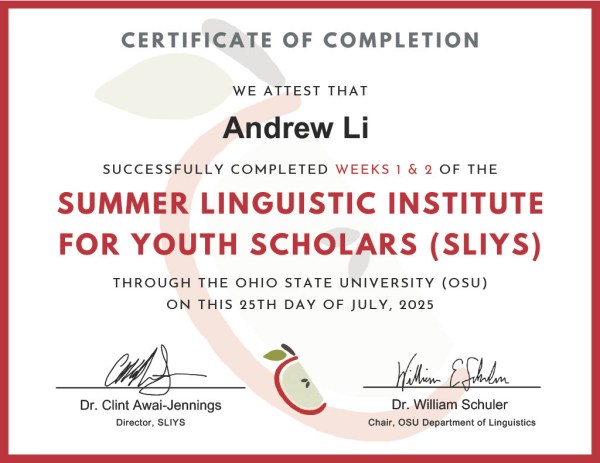
What I Learned (and Loved) at SLIYS: Two Weeks of Linguistic Discovery at Ohio State

This summer, I had the chance to participate in both SLIYS 1 and SLIYS 2—the Summer Linguistic Institute for Youth Scholars—hosted by the Ohio State University Department of Linguistics. Across two weeks packed with lectures, workshops, and collaborative data collection, I explored the structure of language at every level: from the individual sounds we make to the complex systems that govern meaning and conversation. But if I had to pick just one highlight, it would be the elicitation sessions—hands-on explorations with real language data that made the abstract suddenly tangible.

SLIYS 1: Finding Language in Structure

SLIYS 1 started with the fundamentals—consonants, vowels, and the International Phonetic Alphabet (IPA)—but quickly expanded into diverse linguistic territory: morphology, syntax, semantics, and pragmatics. Each day featured structured lectures covering topics like sociolinguistic variation, morphological structures, and historical linguistics. Workshops offered additional insights, from analyzing sentence meanings to exploring language evolution.

The core experience, however, was our daily elicitation sessions. My group tackled Serbo-Croatian, collaboratively acting as elicitors and transcribers to construct a detailed grammar sketch. We identified consonant inventories, syllable structures (like CV, CVC, and CCV patterns), morphological markers for plural nouns and verb tenses, and syntactic word orders. Through interactions with our language consultant, we tested hypotheses directly, discovering intricacies like how questions were formed using particles like dahlee, and how adjective-noun order worked. This daily practice gave theory immediate clarity and meaning, shaping our skills as linguists-in-training.

SLIYS 2: Choosing My Path in Linguistics

SLIYS 2 built upon our initial foundations, diving deeper into phonological analysis, morphosyntactic properties, and the relationship between language and cognition. This week offered more autonomy, allowing us to select workshops tailored to our interests. My choices included sessions on speech perception, dialectology, semiotics, and linguistic anthropology—each challenging me to think more broadly about language as both cognitive and cultural phenomena.

Yet again, the elicitation project anchored our experience, this time exploring Georgian. Our group analyzed Georgian’s distinctive pluralization system, polypersonal verb agreement (verbs agreeing with both subjects and objects), and flexible sentence orders (SVO/SOV). One fascinating detail we uncovered was how nouns remained singular when preceded by numbers. Preparing our final presentation felt especially rewarding, bringing together the week’s linguistic discoveries in a cohesive narrative. Presenting to our peers crystallized not just what we learned, but how thoroughly we’d internalized it.

More Than Just a Summer Program

What I appreciated most about SLIYS was how seriously it treated us as student linguists. The instructors didn’t just lecture—they listened, challenged us, and encouraged our curiosity. Whether we were learning about deixis or discourse analysis, the focus was always on asking better questions, not just memorizing answers.

By the end of SLIYS 2, I found myself thinking not only about how language works, but why we study it in the first place. Language is a mirror to thought, a map of culture, and a bridge between people—and programs like SLIYS remind me that it’s also something we can investigate, question, and build understanding from.

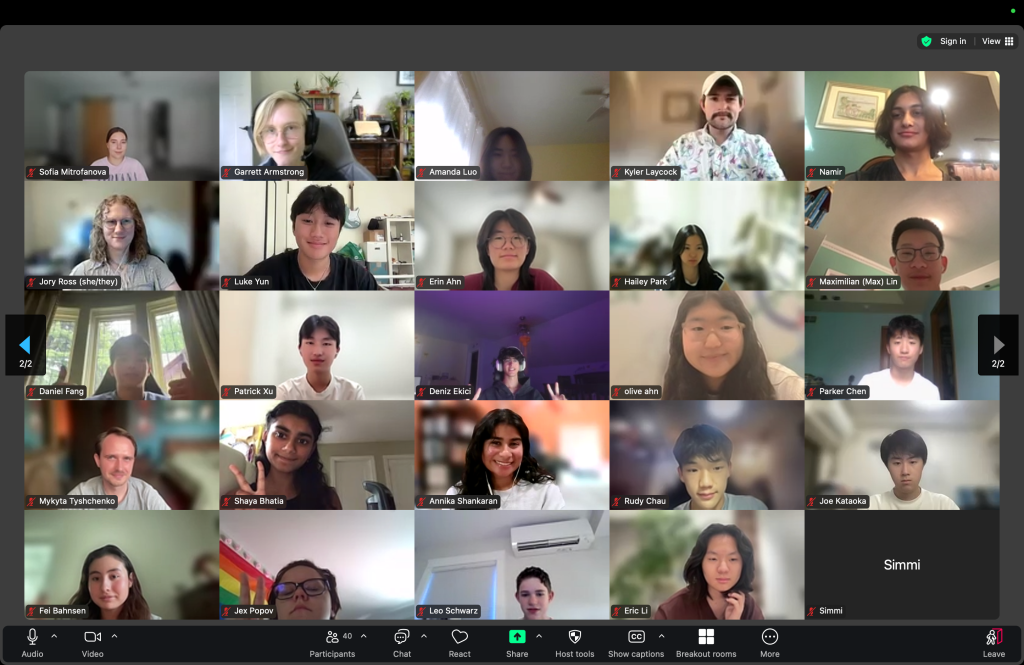
Moments from SLIYS 2: A Snapshot of a Summer to Remember

As SLIYS 2 came to a close, our instructors captured these Zoom screenshots to help us remember the community, curiosity, and collaboration that made this experience so meaningful.

Special Thanks to the SLIYS 2025 Team

This incredible experience wouldn’t have been possible without the passion, insight, and dedication of the SLIYS 2025 instructors. Each one brought something unique to the table—whether it was helping us break down complex syntax, introducing us to sociolinguistics through speech perception, or guiding us through our elicitation sessions with patience and curiosity. I’m especially grateful for the way they encouraged us to ask deeper questions and think like real linguists.

Special thanks to:

  • Kyler Laycock – For leading with energy, making phonetics and dialectology come alive, and always reminding us how much identity lives in the details of speech.
  • Jory Ross – For guiding us through speech perception and conversational structure, and for sharing her excitement about how humans really process language.
  • Emily Sagasser – For her insights on semantics, pragmatics, and focus structure, and for pushing us to think about how language connects to social justice and cognition.
  • Elena Vaikšnoraitė – For their thoughtful instruction in syntax and psycholinguistics, and for showing us the power of connecting data across languages.
  • Dr. Clint Awai-Jennings – For directing the program with care and purpose—and for showing us that it’s never too late to turn a passion for language into a life’s work.

Thank you all for making SLIYS 1 and 2 an unforgettable part of my summer.

— Andrew

How I Published My STEM Research in High School (and Where You Can Too)

Publishing as a high school student can be an exciting step toward academic growth and recognition. But if you’re anything like me when I started out, you’re probably wondering: Where do I even submit my work? And maybe more importantly, how do I avoid falling into the trap of predatory or low-quality journals?

In this post, I’ll walk through a curated list of reputable STEM journals that accept high school submissions—along with some honest thoughts from my own publishing journey. Whether you’re writing your first paper or looking for your next outlet, I hope this helps.


📚 10 Reputable Journals for High School Research (Especially STEM)

These are ranked loosely by selectiveness, peer-review rigor, and overall reputation. I’ve included each journal’s website, review cycle, and key details so you can compare.

  1. Columbia Junior Science Journal (CJSJ)
    Selection Rate: ~10-15% (very selective)
    Subjects: Natural sciences, engineering, social sciences
    Peer Review: Professional (Columbia faculty/editors)
    Cycle: Annual (6–9 months)
    🔗 cjsj.org
  2. Journal of Emerging Investigators (JEI)
    Selection Rate: ~70-75%
    Subjects: Biological/physical sciences (hypothesis-driven only)
    Peer Review: Graduate students and researchers
    Cycle: Rolling (7–8 months)
    🔗 emerginginvestigators.org
  3. STEM Fellowship Journal (SFJ)
    Selection Rate: ~15-20%
    Subjects: All STEM fields
    Peer Review: Canadian Science Publishing reviewers
    Cycle: Biannual (4–5 months)
    🔗 journal.stemfellowship.org
  4. International Journal of High School Research (IJHSR)
    Selection Rate: ~20–30%
    Subjects: STEM, behavioral, and social sciences
    Peer Review: Author-secured (3 academic reviewers)
    Cycle: Rolling (3–6 months)
    🔗 ijhsr.terrajournals.org
  5. The Young Researcher
    Selection Rate: ~20–25%
    Subjects: STEM, social sciences, humanities
    Peer Review: Faculty and researchers
    Cycle: Biannual (4–6 months)
    🔗 theyoungresearcher.com
  6. Journal of Student Research (JSR)
    Selection Rate: ~70–80%
    Subjects: All disciplines
    Peer Review: Faculty reviewers
    Cycle: Quarterly (6–7 months)
    🔗 jsr.org
  7. National High School Journal of Science (NHSJS)
    Selection Rate: ~20%
    Subjects: STEM and social sciences
    Peer Review: Student-led with academic oversight
    Cycle: Rolling (3–5 months)
    🔗 nhsjs.com
  8. Journal of High School Science (JHSS)
    Selection Rate: ~18%
    Subjects: STEM, arts (STEAM focus, quantitative research)
    Peer Review: Academic reviewers
    Cycle: Quarterly (4–6 months)
    🔗 jhss.scholasticahq.com
  9. Curieux Academic Journal
    Selection Rate: ~30–40%
    Subjects: STEM, humanities, social sciences
    Peer Review: Student-led with professional oversight
    Cycle: Monthly (fast-track: 2–5 weeks; standard: 1–3 months)
    🔗 curieuxacademicjournal.com
  10. Young Scientists Journal
    Selection Rate: ~40–50%
    Subjects: STEM (research, reviews, blogs)
    Peer Review: Student-led with expert input
    Cycle: Biannual (3–6 months)
    🔗 ysjournal.com

🧠 My Experience with JHSS, JSR, and NHSJS

1. Journal of High School Science (JHSS)
This was the first journal I submitted to on November 13, 2024. The submission process was straightforward, and the portal clearly tracked every stage of the review. I received feedback on December 29, but unfortunately, the reviewer seemed unfamiliar with the field of large language models. The decision was based on two Likert-scale questions:

  • “The paper makes a significant contribution to scholarship.”
  • “The literature review was thorough given the objectives and content.”

The first was marked low, and the second was marked neutral. I shared the feedback with LLM researchers from top-tier universities, and they agreed the review wasn’t well-grounded. So heads up: JHSS does have a formal structure, but you may run into an occasional reviewer mismatch.

2. Journal of Student Research (JSR)
Originally, I was going to submit my second paper here. But I ended up choosing NHSJS because JSR’s review timeline was too long for my goals (6–7 months vs. NHSJS’s 3–5 months). That said, JSR has one of the clearest submission guides I’ve come across:
👉 JSR Submission Info
If you’re not in a rush and want a polished process, it’s a solid option.

3. National High School Journal of Science (NHSJS)
This is where I published my first solo-authored research paper (see my earlier post). What stood out to me:

  • Quick response times
  • Detailed and constructive reviewer feedback

My reviewers gave me 19 major and 6 minor suggestions, each with specific guidance. It was incredibly helpful as a student navigating scientific writing for the first time.

That said, the journal’s submission format was a bit confusing (e.g., its citation style is non-standard), and the guidelines weren’t always followed by other authors. I had to clarify formatting details directly with the editor. So: highly recommend NHSJS—just make sure you confirm your formatting expectations early.


Final Thoughts

If you’re serious about publishing your research, take time to explore your options. The review process can be slow and sometimes frustrating, but it’s one of the best ways to grow as a thinker and writer.

Let me know if you have any questions. I’d be happy to share more from my experience.

— Andrew

Blog at WordPress.com.

Up ↑